10 Cinematic Pairings That Reflected The Spirit Of 2025
Stephen David Miller explores the year via twenty interconnected films.

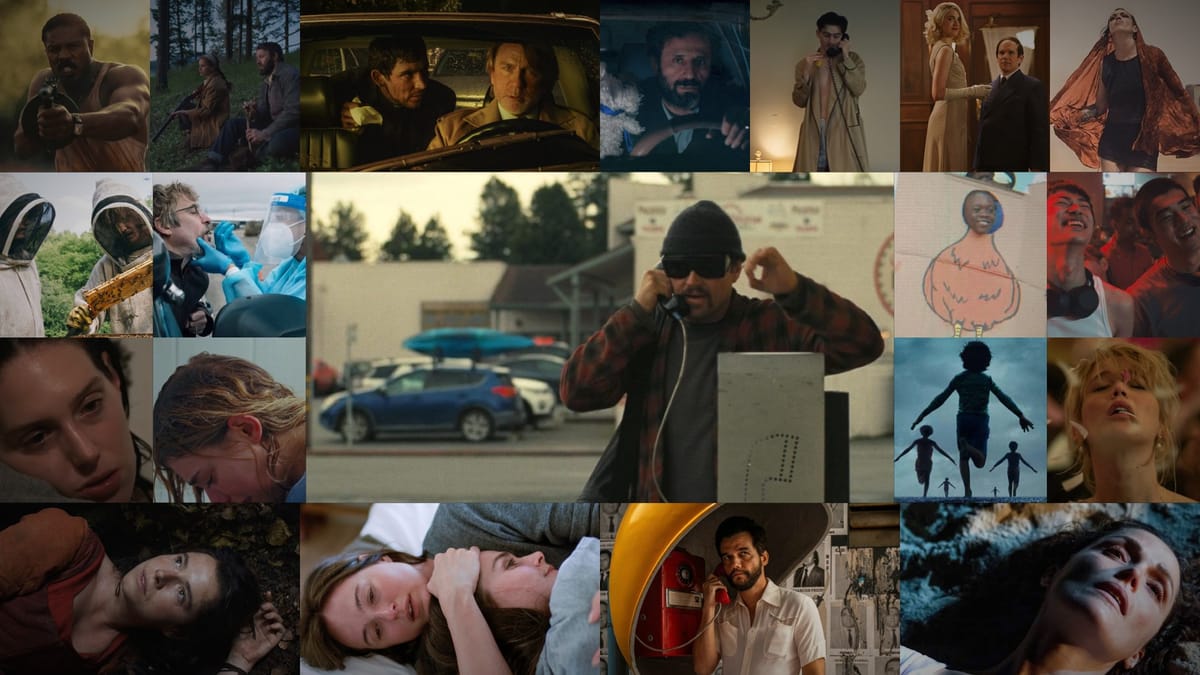
For the third year in a row, I'm pleased to share with you Stephen David Miller's 10 cinematic pairings of the year. When I first saw this piece on Stephen's blog, I was so taken with the idea that I asked him if he'd allow me to publish it on Decoding Everything. Thankfully, he obliged. A quick note: there aren't any spoilers per se but you should assume Stephen will be discussing the themes and basic plot elements of each film named. If you enjoy this article, check out Stephen's cinematic pairings from 2024 and 2023. You can also listen to his podcast, The Spoiler Warning. -David Chen
Ocean Waves
If I am waiting, should I be waiting?
If I am wanting, should I be wanting?
If I am hopeful, should I be hopeful?
When all around me…all around me…
- The Decemberists, “A Beginning Song”
Often in the process of thinking through these lists, I’ll catch myself listening to a song on repeat. It percolates, shedding whatever meaning the artist first ascribed to it to become my lens for processing the year. If 2024 was an anthem to preserving the authentic self inside, 2025 felt seasick, overwhelmed by outer forces. What are we meant to do when the world feels unsteady? It’s paralyzing, calling every instinct into question. Should I be wanting at a time with so much visible destruction? Should I be hopeful as the country is caving in? Should I focus on yet another essay about movies, when all around me…all around me…?
Film, like music, has a tendency to shapeshift, becoming entangled with the moment that receives it. None of us walks into the theater empty-handed. We carry our context, personal and collective, and find shards of it reflected on the screen. What follows is a list of the things I saw reflected. It's a countdown of my favorite films of the year, pairing 20 different titles into 10 related themes. The exercise of building these always has a clarifying effect for me. I hope it has the same effect for you.
10. Dancing To Oblivion—‘Happyend’ and ‘Sirāt’
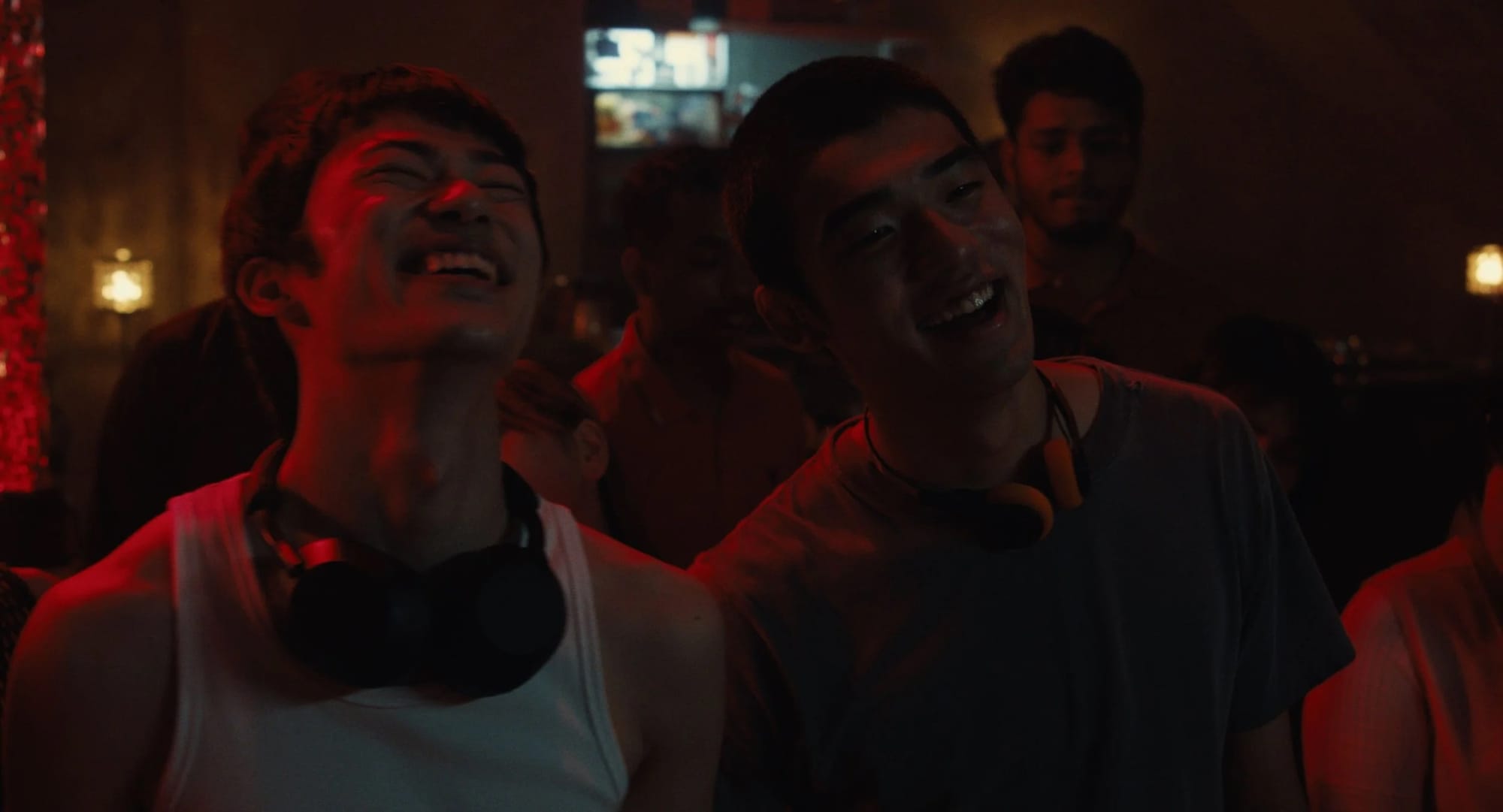
It was a year that teetered on the brink of an explosion: the lit fuse of fascism, the impending threat of war. In the face of such daunting conditions, it’s tempting to throw up our hands in defeat. These are films about the tug of nihilism.
Happyend is billed as a science fiction film, but there is nothing unfamiliar in its premise. Neo Sora’s debut feature is set in a near-future Tokyo, where a looming natural disaster has fueled an authoritarian shift, characterized by insular leadership, opaque “security” measures, and a xenophobic crackdown on dissent. We follow a group of high-school seniors they near their graduation, most prominently Yuta (Hayato Kurihara) and Kou (Yukito Hidaka). The two best friends share a love of electronic music; to them, it is an outlet for rebellion. When the police storm into an unlicensed club, they dance until the DJ is forcibly dragged away. That ethos extends to their behavior at school, where they pull elaborate pranks to rattle their despotic principal. But as tensions continue to rise and they grow closer to adulthood, the students question their larger moral responsibility. Is it enough to thumb your nose in the face of existential danger? Should we really dance as the earth is beginning to shake?
Sirāt takes this concept to literal extremes. Óliver Laxe begins his tone poem at a Saharan desert rave, in a country on the verge of World War III. The sun bears down and the bassline thrums, as a father and son interrogate the revelers. The two are asking questions we can barely suss out to an audience that's largely unresponsive—most are too busy succumbing to the rhythm. Eventually a story will emerge from this, a psychedelic odyssey that veers wildly in and out of genres. But the trajectory of the film is less a winding mountain path than it is a climbing volume slider, amping up that opening scene to its logical conclusion. The sun magnifies into hellfire, the bassline begets an explosion, and that checked-out desire to meld with the beat becomes a total disintegration of self. Whereas Laxe has been criticized for minimizing real political conflict, I’d argue that’s the message he's intending to convey: the impulse to tune out the suffering around you. Few drugs are more potent than the notion that everything is meaningless. Take a hit of that fiction, numb your heart, and disappear.
Happyend is available on VOD. Sirat has played in limited release and is expected to be on VOD soon.
9. Coming Home To Roost—’On Becoming A Guinea Fowl’ and ‘Weapons’

A natural response to the evil of this world is to avert our eyes and retreat. This can be true both of passive observers and of those who are directly in its crosshairs. I concluded last year’s list with the idea that cruelty can separate self from self. These films explore the horror of that fissure, and the intensity with which it snaps back.
At the outset, the prevailing mood of On Becoming A Guinea Fowl is one of disaffection. Rungano Nyoni’s film opens with Shula (Susan Chardy) finding her uncle’s lifeless body on an unlit Zambian road. Rather than betray sadness or surprise, she responds as one might to engine trouble: let out a sigh of frustration, make a perfunctory call, and wait for someone useful to arrive. This matter-of-factness is shared by multiple women in her orbit, a trait none seem particularly interested in unpacking. While the others distract themselves with funeral logistics and pretty inheritance disputes, Shula uncovers a web of dark secrets and repressed memories buried within her family history. What follows is a brilliant exploration of the way obvious truths get swept under the rug, and the distractions that forestall a deeper reckoning. The guinea fowl, we learn in an educational children’s program, shrieks to warn others that a predator is lurking. This is a story about the decades’ long gestation of a screech.
Two images from Weapons have stuck with me this year, and they bookend Zach Cregger’s twisty horror/thriller. The first is that of a child staring blankly, arms stretched out like wings, barreling forward absent any intention. This surveillance camera footage looms large over the residents of Maybrook, Pennsylvania, where 17 third-grade classmates seemingly vanished in the night. The parents are shell-socked, and angry, and desperate for answers. But like the mourners in Guinea Fowl, in their rush to settle the score, they reach for scapegoats and ignore the deeper mystery—a house with the curtains drawn, a boy suddenly gone mute, a hint of menace undergirding conversations. While others attempt to weaponize their anguish into action, Justine (Julia Garner) has a gnawing sense that something else is off. Tug at that thread and the curtain unravels, substituting mystery with a flesh and blood monster and creeping dread with violent retribution. Which leads me to the second image, the visceral ending whose details I won’t spoil. Except to say: Feelings, suppressed, tend to rear their heads with force.
On Becoming A Guinea Fowl and Weapons are streaming on HBO Max.
8. The Oppressiveness Of Fine—‘If I Had Legs I’d Kick You’ and ‘Die My Love’

The instinct to bottle up uncomfortable truths permeates our culture. No matter how intense our worry becomes, “moderate” voices insist to us that everything is fine. But energy needs an egress, however hard you tamp it down. These are films about women who have reached a breaking point.
If I Had Legs I’d Kick You has been described as an unflinching look at raising children, and certainly, that theme is on its mind. Mary Bronstein’s chronicle of an overworked therapist trying to care for her daughter doesn’t paint the subject in a positive light. Rose Byrne portrays Linda with an almost inhuman exhaustion; the resignation in her eyes is all-consuming. However, parenting is only the catalyst for her existential crisis. What pours gas on the flame is the way every adult lets her down. From the out-of-town husband who mollifies via voicemail, to her maddeningly ineffective colleague, to the hospital worker who treats her like a troublemaking student, everyone is repeating the same message: “Things should be okay. Have you tried being okay?” Lip service aside, no one seems interested in understanding why she’s hurting: conflicting responsibilities, back-to-back sleepless nights, the hole in her ceiling blooming like an ulcer. None of these are insurmountable alone, but problems only balloon when kept in darkness. Rather than help release the pressure, the world demands she swallow it and chides her when she can’t. It makes for a nightmare.
When the director of We Need To Talk About Kevin casts the star of mother! to play a psychologically troubled housewife, it’s natural to assume her troubles are related to parenthood. But to my mind, this prevailing read of Die My Love is both wrong and perversely ironic. Because if there’s one thing about which Grace (Jennifer Lawrence) is consistent throughout Lynne Ramsay’s fever dream, it’s that her baby isn’t the problem. If anything, he’s one of her few remaining sources of joy. Yet the audience, like well-meaning family and friends, leapfrog her words to land at the simplest diagnosis. “Everybody goes a little loopy the first year.” These bromides only reinforce the fundamental problem, which is the widening gulf between Grace and other people. The less willing they are to pause and meet her on her level, the more unbridgeable the gap appears. She feels ill at ease in her new life of wine moms and pool parties and buttoned-up, faux domestic bliss. She longs for fire and blood, for people who say what they mean and act on it directly rather than sanding every edge with platitudes. For as abrasive as it is to watch her (repeated) self-destruction, it also gave me a certain, liberating thrill. At least someone isn’t pretending.
If I Had Legs I’d Kick You is available on VOD. Die My Love is streaming on MUBI.
7. Garbled Signals—‘Bugonia’ and ‘Eddington’
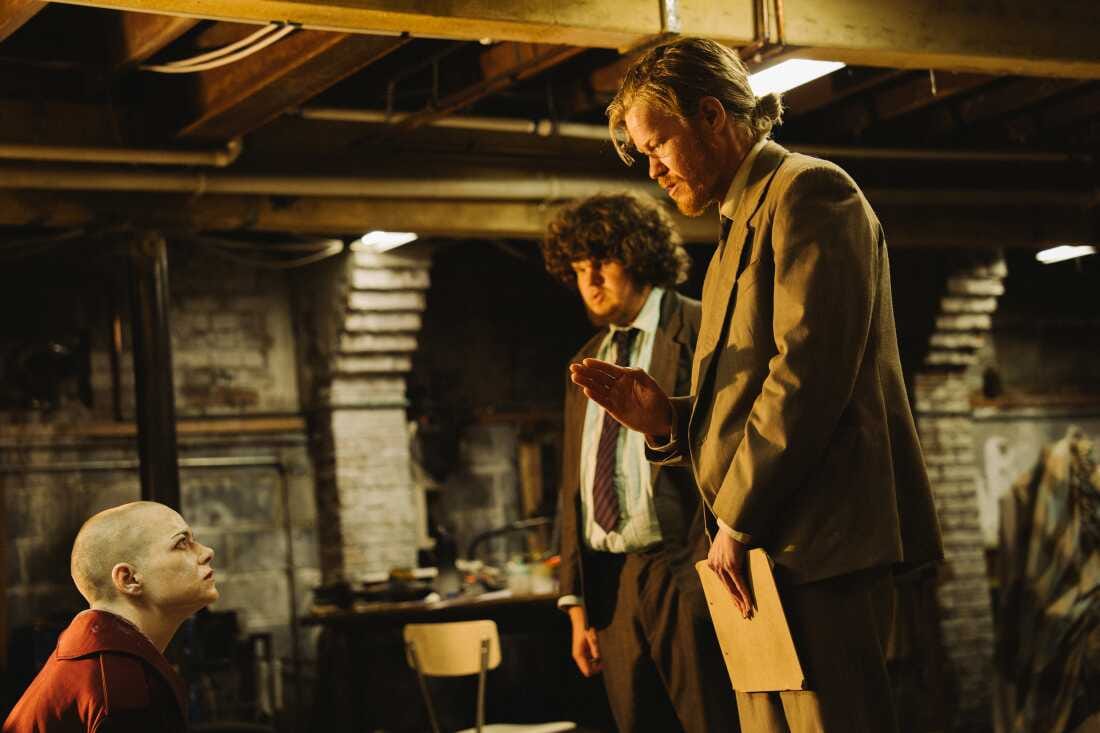
“We are being lied to.” That concept, once the hallmark of tinfoil-hat conspiracy theorists, has now become the dominant mainstream view. Where previously there was the assumption of a shared reality, there now is only narrative and attention. Meme stocks, betting markets, and crowdsourced policy positions. Photorealistic videos conjured by a prompt. Documented murders overridden by a tweet. These films are about that erosion of truth, exploring the way societal dynamics mingle with willful disinformation to radicalize the people who consume it.
Bugonia is an upsetting film about an upsetting character, made more upsetting by our fear that he has a point. Yorgos Lanthimos’ bleak comedy centers around Teddy (Jesse Plemons), a YouTube-pilled extremist who has convinced himself there are Andromedans in our midst. Through painstaking “research”, he’s concluded that humanity is on the brink of subjugation, so he takes drastic, heroic measures meant to thwart it. Namely: kidnapping a pharmaceutical CEO he suspects to be an alien, shaving her head, and tying her up in his basement. As we watch him interrogate Michelle (Emma Stone), we’re aghast yet also bizarrely understanding. Though his methods are ghastly and his logic outlandish, he really is picking up a signal. It stems from a papered-on smile in a corporate marketing video, or a cheery mission statement that rings hollow. The queasy sense of being squashed by nefarious forces. Teddy looks to the stars and hunts for otherworldly beings, whereas we suspect more terrestrial explanations. But something inhuman, regardless of its origin, is buzzing in the system.
I suspect my inclusion of Eddington here will be polarizing. Taken as a satire of How Things Were In 2020, Ari Aster’s neo-western can seem like a trollish, “both sides” provocation. But as with American Fiction a few years prior, I see it less as a biting societal critique than as a cave dive into personal neuroses. It’s messy and exhausting to be stuck in Aster’s head, in a way that I find painfully familiar. To live through the beginning of the pandemic was to experience a jumble of contradictions: bound by a collective trauma that left us fully disconnected, defending the value of worthwhile institutions while dismantling institutional propaganda, convicted to decenter oneself to the point of borderline egotistical self-awareness. Call the last one fraudulence, or imposter syndrome, or merely the human condition—if you burrow too deeply inside of your skull, you’ll find that everything has some element of performance. This film is about a moment when society burrowed too deeply, blending genuine wrongs with psychic discomforts until the two became one monster, indivisible. People not only lost faith in expertise and authority; they lost faith in their own moral compass. The Emma Stone of Eddington needs no ponytailed conspiracist to bind her or accuse her of deception. She’s frozen, distrusting her memory and concept of self.
Bugonia is streaming on Peacock. Eddington is streaming on HBO Max.
6. Root Rot—‘Sinners’ and ‘Train Dreams’
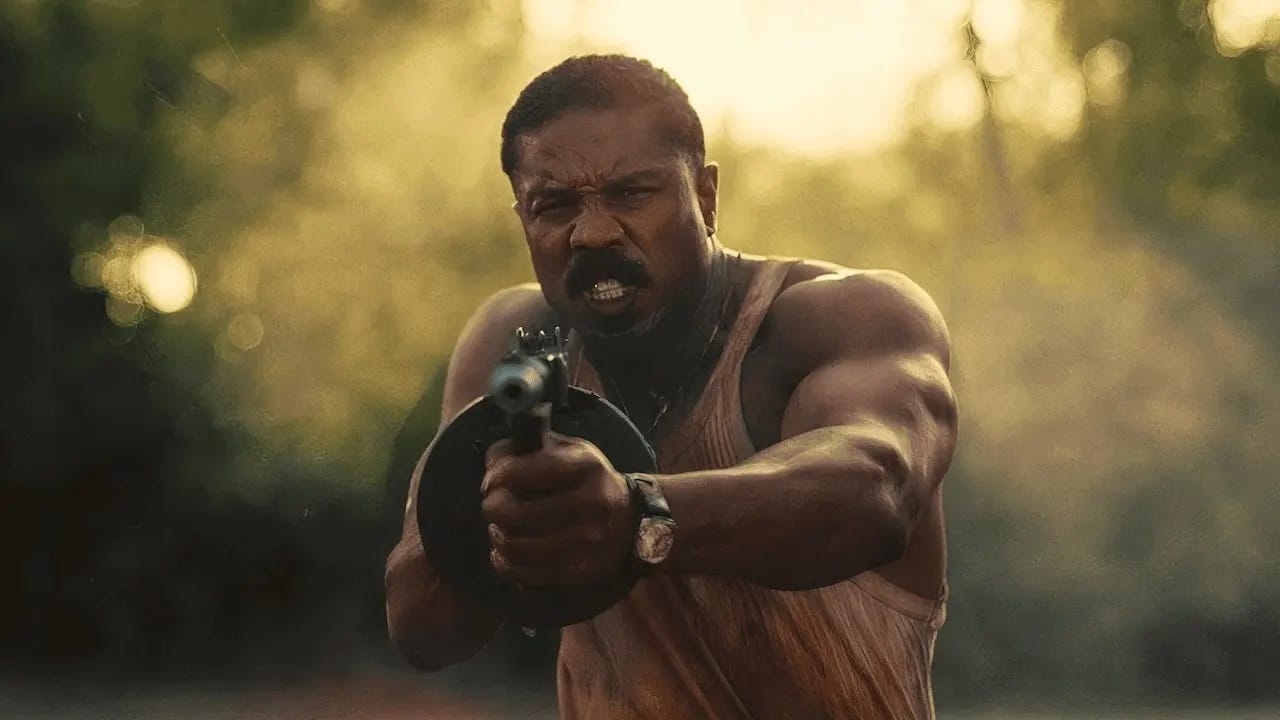
The story of our collective unraveling doesn’t begin in 2020. There are fractures that have always existed in this country, an ugliness that stems from the foundation. These are films about men who lay claim to a parcel of the American Dream and are confronted by the rot beneath the soil.
Sinners is a towering statement which resists simplistic interpretation. Ryan Coogler's epic musical horror has many ideas on its mind, including the siren song of assimilation, the empty promise of capitalism, and the struggle for an artist to retain their spark in an industry that co-opts and commodifies them. But if there's one thing these themes all have in common, it's that they stem from a contradiction at the heart of America's founding. Namely, the pursuit of individual liberty within a system built on exploitation. Try as one might, no one escapes it unscathed. Leave the shelter of a church to forge a new identity, only to wind up being stranded in a juke joint. Strain to keep your voice above the whir of the collective, and find yourself alone, outgunned and hoarse. It’s a cyclical war against a real undying creature, one that doesn’t hide in shadows or ask permission—it simply takes. Its uniforms may rotate, but its spirit stays unchanged. Yet even if the war seems unwinnable, there’s power in choosing to fight. While Sammie (Miles Caton) sings for somebody to take him in their arms, he is held by the traditions he’s set himself apart from and by a future that will set itself apart from him. Concentric rings combine into something sturdy.
You’d be hard pressed to find a work of art more tonally dissimilar to Sinners than Train Dreams, Clint Bentley’s hushed portrait of an early 20th century logger. The protagonist, Robert Grainier (Joel Edgerton), carries a chosen sort of silence, a response to life's unspeakable contradictions. Early in the film, we watch him participate in a racially motivated murder. He could no more explain his actions than a newly-turned vampire could explain why it sings. That impulsive sin casts a pall over the rest of his life. Though he strives to find some semblance of an authentic way of living, he’s haunted by reminders of brutality. Widowmakers falling like acts of senseless violence. Predatory industry, eating through its labor like a wildfire racing through the underbrush. What’s the point of all this beauty if it’s sprung from poisoned ground? Why get attached if it can all go up in smoke? In place of a satisfying answer, the film leaves us with a sudden, soaring montage whose sentiment echoes that of the dance scene in the juke joint. The past and future, informed by pain, colliding to create deeper meaning.
Sinners is streaming on HBO Max. Train Dreams is streaming on Netflix.
5. Dreaming Alone—‘Marty Supreme’ and ‘Blue Moon’
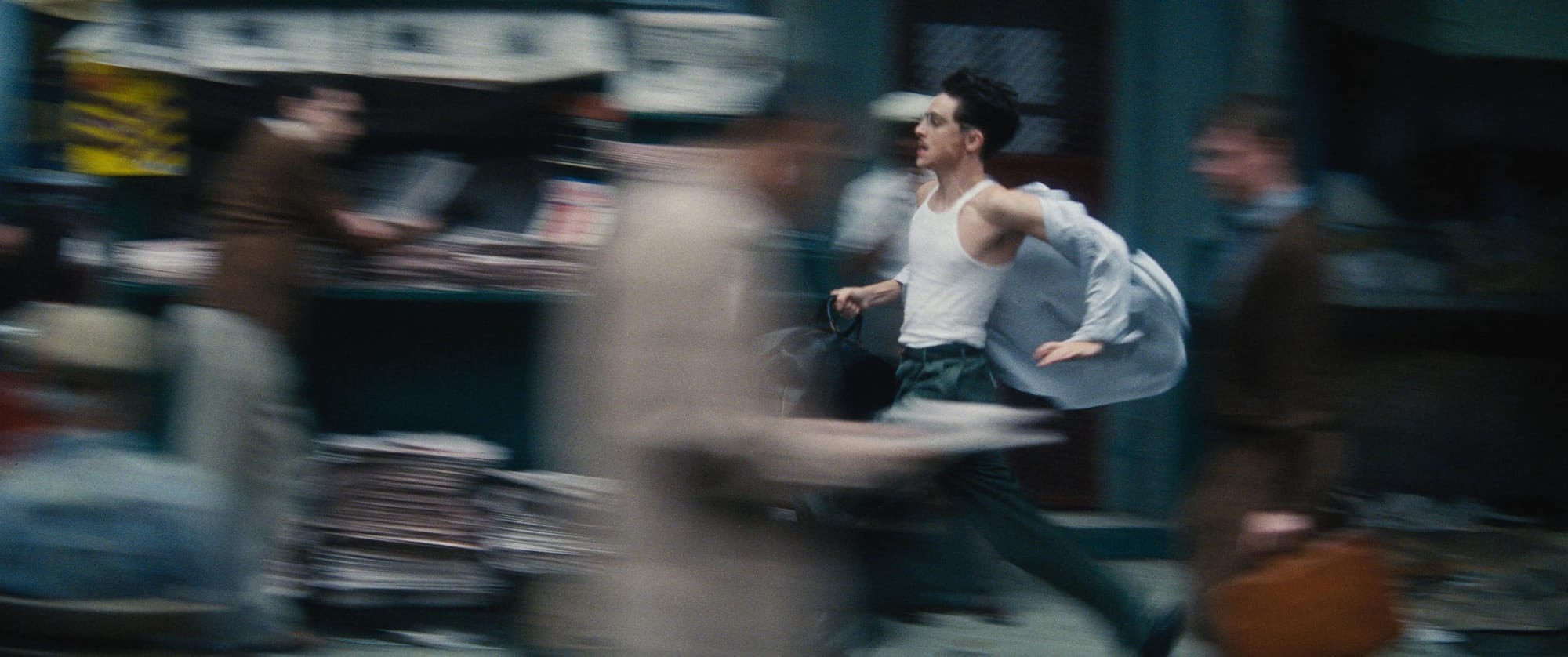
The American Dream is an arrow pointing upward, its promise bounded only by intention. Push hard enough, believe in yourself fervently enough, and all of this and more will be yours. It’s an intoxicating myth which can easily ensnare you. These are stories about dreamers who develop tunnel vision, and the life they trample over in the process.
Marty Supreme is a study of an irredeemable narcissist in the trappings of an inspirational picture. Marty (Timothée Chalamet) is not a brash kid in need of a minor attitude adjustment; he’s a sociopath, a toxic user and discarder attuned only to the pursuit of his own greatness. It’s no accident that the ideal scenario for the rising table tennis star is a brief and (at best) Pyrrhic victory: a single match won in a barely-recognized sport which we know will be forgotten in the future. Yet to Marty, this is of infinite worth, an end that justifies every means. Josh Safdie imbues it with the verve of a riveting sports drama, for the same reason Trainspotting crackles like a drug trip: It’s a window into the universe as its protagonist perceives it, while the darker truth frays around the edges. Marketing encourages us to “dream big” through Marty, like an addict waxing poetic about “choosing life." Edifying in principle, destructive in context. But finger-wagging biopics and D.A.R.E programs stumble because they focus on the danger without acknowledging the hook. Watching Marty steamroll every bystander in search of his next fix, I felt like Kevin O’Leary gaping from the audience: filled with a mixture of awe and disgust, aware of the wreckage but caught in its gravitational pull. There really is a “zone” and you really can lock yourself inside it. It’s a black hole, where nothing and no one can reach you.
“Do you ever think your entire life is a play, and 99% of the people in it have got no lines, they're just extras?” This line from Blue Moon isn’t spoken by Lorenz Hart (Ethan Hawke), yet it summarizes both his and Marty’s affliction. Or perhaps, to be more charitable to Richard Linklater’s self-destructive subject, it’s the intrusive thought he’s spent a lifetime trying to shake. Drowning his sorrows in a Manhattan bar on the heels of the success of Oklahoma!, the once vaunted lyricist is no longer a starry-eyed main character. He’s endlessly reflective, both of his flaws and of the fact that he’ll continue to indulge them. He knows the world is passing him by and that he is the reason it’s happened: his cynicism, his drinking, his knee-jerk compulsion to prove that he’s the smartest in the room. And Lorenz very likely is the smartest person in the room, but the number willing to occupy it shrinks by the day. Rejecting his former partner's new musical as cloying and easy, he yearns for “a hard earned, unsentimental joy.” A joy so obfuscated, even he can’t seem to find it. He’s drunk with beauty (“and italicize the word drunk”), but he’s so fixated on the idea of it he’s closed himself off to its particulars. Instead he’s glued to the barstool, pining over starlets like the Ghost of Marty Future, unable to see beyond his lost ambition. As exhilarating as it is to be on the cusp of some achievement, those fleeting moments aren’t what make life precious. Beauty is found in the long swaths in between.
Marty Supreme is currently in theaters. Blue Moon is available on VOD.
4. The Other Side Of Drowning—‘The Chronology of Water’ and ‘Sorry, Baby’

There are moments that hit with force, and then there is everything else. Our triumphs and traumas inform who we are, but they do not need to define us. These films shift the focus from egotists to the people they can hurt, and the scars left in the wake of their abuses. With nonlinear narratives and jarring tonal swings, they express the messy work of healing and integration.
The Chronology of Water is not my favorite film of the year, but it’s the one that I most vigorously want to champion. I found Kristen Stewart’s directorial debut to be utterly astonishing and I’m sad that it’s garnered so little attention. Based on Lidia Yuknavitch’s memoir of the same name, the coming-of-age drama follows the writer from adolescence through adulthood, tracing the abuses she suffered at the hands of her father, the cycle of addiction that ensued when she broke free, and the development of her queer identity and raw poetic voice. To write that in a sentence feels misleading, though, implying a tidiness that exists in neither her story nor the telling. “I thought about starting at the beginning,” Lidia (Imogen Poots) informs us, “but that’s not how I remember it.” Mimicking the fragmentary structure of the novel, Stewart forgoes exposition in favor of immersion, letting present-tense sensations collide with partial memories, and biography blur with creative fiction. This amorphousness is a perfect complement to the thought life of her subject, as she strains to draft a narrative that fits. Building a cohesive sense of self is painful, and Lidia topples every literary trope in the process. Perfect victims, hurt people hurting people, weepy redemptive arcs—none of them seem to capture her experience. She wants to reconcile the pain she’s endured and the pain she’s inflicted with the complexity of life on the other side of drowning.
Agnes (Eva Victor), too, resists being reduced to facile conventions. The Sorry Baby protagonist is a PhD candidate at a liberal arts college in New England. After she’s sexually assaulted by her doctoral advisor, she can barely find the words to describe it. How could she, this beaming intellect and wry observer of behavior, have her fullness be collapsed into the word “victim?” Language fails after something so unthinkable. Eva Victor is a comedian, not a poet, and so we process Agnes’ trauma through that prism—attunement to the absurdity of living. Alongside her grief, we tease out more peculiar components. Laughably ineffective doctors and HR reps, theoretically put in place to help her. Strangers’ clumsy attempts at solemn empathy. The lingering discomfort when That Subject is brought up, how it seems to suck the air out of the room. We’re asked to recognize how bizarre, how human it is to be caught between so many conflicting tones, to be somber in a universe that’s patently ridiculous, or to laugh despite glaring reasons for despair. Victor breathes new life into the tension.
The Chronology Of Water is currently playing in limited release. Sorry, Baby is available on HBO Max.
3. Between The Lines—‘Sentimental Value’ and ‘Hamnet’
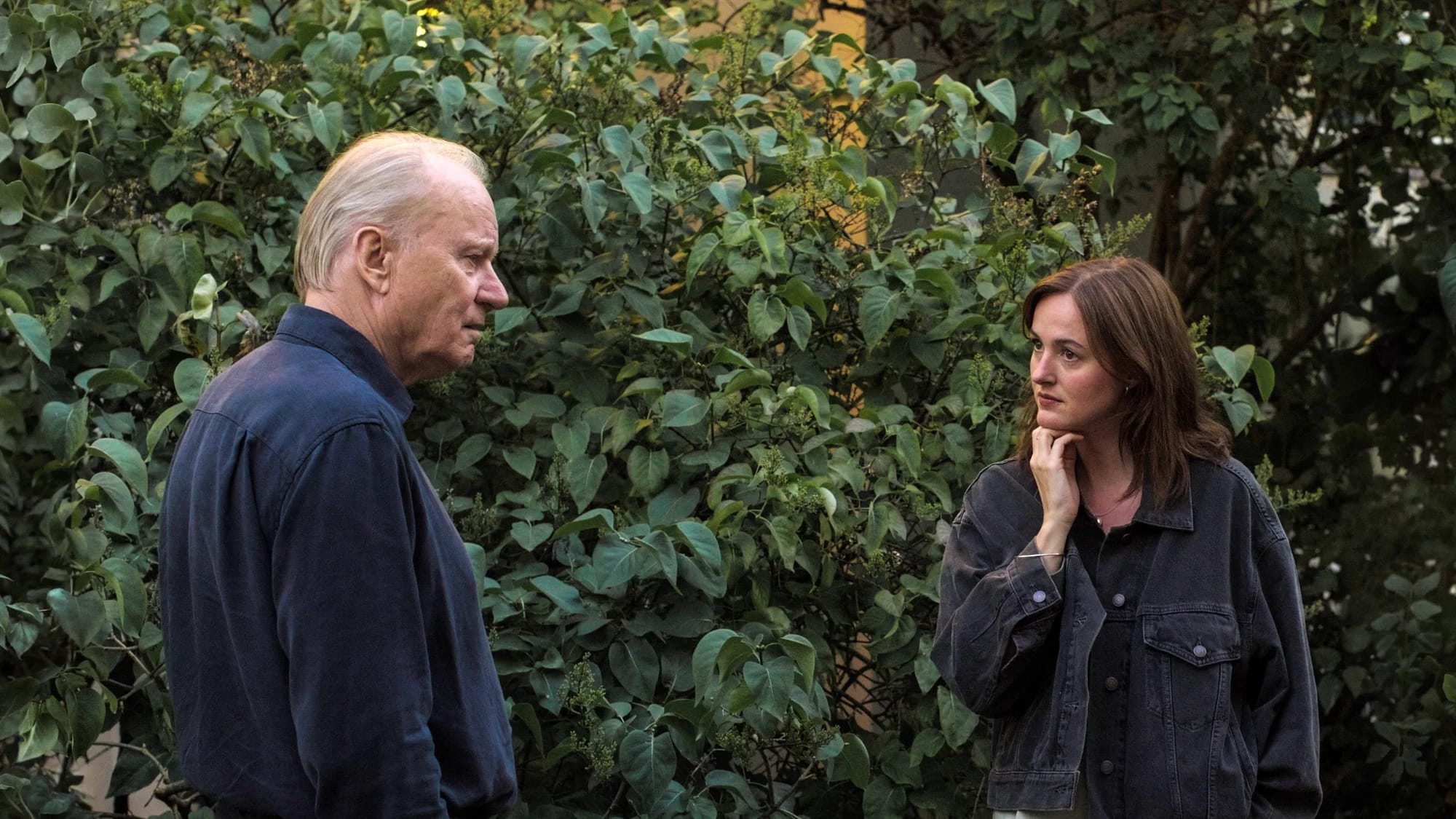
For as much as I try to put these themes in writing, something inevitably gets lost in translation. Art isn’t meant to tell, but to impart. There’s a magic to experiencing it, communicating feelings we couldn’t voice directly, or imbuing things we know with deeper weight. These are films about that alchemical process.
It’s difficult to put my love for Joachim Trier’s Sentimental Value in words, which is fitting considering its premise. Gustav (Stellan Skarsgård) is a renowned filmmaker and largely absent father, who invites his daughters to collaborate on an upcoming project. Agnes (Inga Ibsdotter Lilleaas) is suspicious yet cautiously receptive; Nora (Renate Reinsve) storms out of the room. Why was Gustav so distant, and why his newfound urgency? What is that heaviness Nora carries behind her eyes? Questions abound whose answers tend to go unspoken, but meaning meets us via other channels. Static shots of their family home, presented without sentiment, somehow conjure up a wellspring of emotion. A monologue on the page, read verbatim by two actresses, splits into two distinctive, personal confessions. A wordless scene, presented just before the credits, moves us in spite of evident artifice. There’s something precious being transmitted, from Gustav to his family and from Trier to those of us who watch the film. I still don’t have a name for it, but it’s worth its weight in gold.
Hamnet is a movie that manipulates its audience, but far from feeling cheated, I receive it as a gift. In her drama about Agnes (Jesse Buckley) and William Shakespeare (Paul Mescal) reeling from the loss of a child, Chloé Zhao is reaching for extremes. We swerve between whispered vows, table-flipping arguments, and ear-splitting howls of inconsolable grief. It’s stunning but distancing, too massive to relate with, blowing out the speaker on every emotion. The mourning couple is transformed into impenetrably tragic figures, characters on a stage too lofty to reach. None of this is a coincidence; it’s a prelude. Having established this uncrossable divide, Zhao suddenly removes all separation, collapsing Agnes with William with Hamnet with “Hamlet” with us. She invites us to reach out and touch them, to pierce the veil and step into the realm of universal human suffering. To share not only in a fictional tragedy, but in the pain of every person whom it stirred. To add our own stories and carry them, broken, together. The experience of sobbing in that Toronto theater alongside some hundred sobbing strangers, remains one of my most cherished memories of the year. Art rearranged us, manipulated us into a state of communal catharsis. Feel free to call it cheap. I call it transcendent.
Sentimental Value is available on VOD. Hamnet is expected to be available on VOD soon.
2. Open The Box, Pick Up The Phone—‘It Was Just An Accident’ and ‘Wake Up Dead Man: A Knives Out Mystery’

Those moments of transcendence are the exception to the rule. More often, I find I’m weighed down by specifics. We’re living through a time that offers ample cause for dread, and if I’m not careful I can let that dread consume me. It’s the Pavlovian urge to scroll that ties a knot inside my stomach. The logic of the dark intrusive thought. Wrongness piles up, becomes a puzzle.
These are films about that inward spiral, featuring characters who, by engaging with the hatred that surrounds them, are nearly strangled by the terms with which it argues. They challenge us to see the world with clear eyes but also to take a leap of faith, embodying the world as we believe it ought to be.
Jafar Panahi has spent most of his career as a political target, at odds with Iran’s authoritarian government. His films have been censored, his movement has been stifled, and he’s been imprisoned for “collusion” against the Republic. It Was Just An Accident feels, in many ways, like a reckoning with that injustice. Vahid (Vahid Mobasseri) is hurting, haunted by the years he spent tortured as a political dissident. When he encounters a man he suspects to be his former captor, he snaps. He knocks him unconscious, locks him in a box, loads it in his van, and hits the road. Finally with the upper hand, Vahid debates his next move. At first, he’s preoccupied by a factual dilemma: Is the man in the box actually his abuser? Soon other, murkier questions rise to the surface. Even if it is that man, would it be just for him to kill him? Wouldn’t vengeance only perpetuate brutality? On the flip side, wouldn’t mercy further imbalance the scales? These are heavy concerns he’s grappling with, and ones which the film will ultimately return to. But what I love most about this story is a moment when Vahid picks up someone else's phone, prompting him to derail his mission and rescue a family in peril. It’s illogical, distracting both from the plot and from resolving his moral dilemma. Few things that matter are airtight. Panahi urges us to lift the lid, to let the light in on our wrestling, to take a breath and reconnect with something bigger.
A similar pause occurs in Wake Up Dead Man. Ninety minutes in, Father Jud (Josh O’Connor) has found himself at the center of two complementary mysteries. One has all the hallmarks of a Rian Johnson whodunnit: a murder most foul, a hammy ensemble, a labyrinth of clues and disproved hunches. The other is more enduring, and not typically the purview of blockbusters or Southern Fried detectives, involving the hatred seething within the body politic. How can we address it without conceding to its logic? Strong arguments could be made that most institutions—this country, the Church—are beyond the point of saving, and upon sober reflection, I’m often inclined to agree. But what can we do with conclusions that lead to the dead end of hope, when there’s no trick wall or crawlspace in sight? Jud opts to take a beat and step out of the questioning, grinding both puzzles to a halt in favor of ministering to a stranger in need. He doesn’t preach, but I hear it as a sermon: Lay down your instinct to strategize, to obsess over the rot beyond your reach. Don’t let cooler heads prevail. Hope in spite of reason, and mine for love wherever you catch a glimmer.
It Was Just An Accident is available on VOD. Wake Up Dead Man: A Knives Out Mystery is streaming on Netflix.
1. Counter-Rhythms—‘One Battle After Another’ and ‘The Secret Agent’
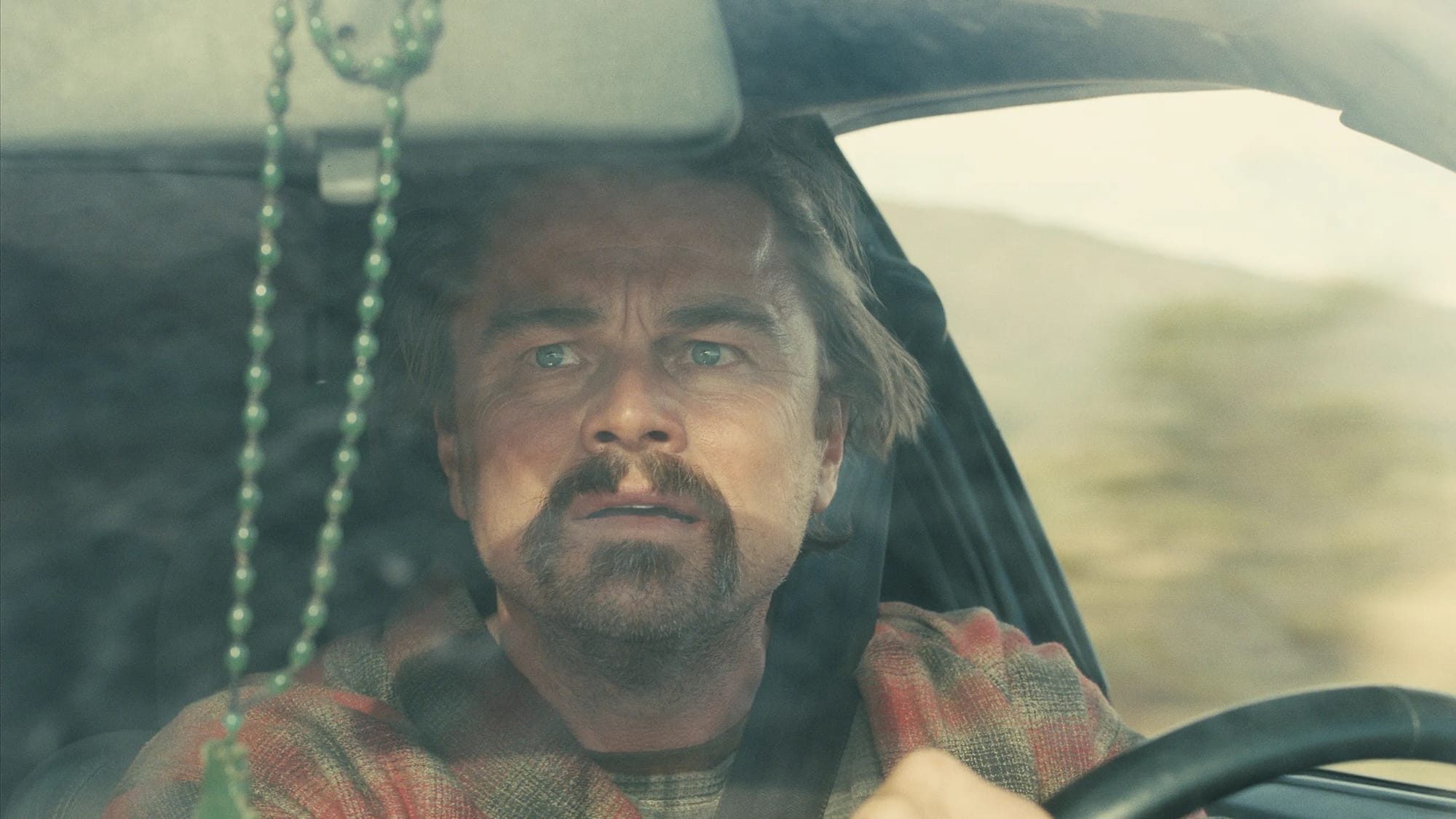
At the start of this list, I mentioned that 2025 seemed to teeter on the brink of an explosion. But as any historian or Bluesky scold is apt to interject, we have always been teetering on the brink. It’s the same oafish enemy, same thin justifications, same nihilistic drive towards destruction. These films speak to the cyclical nature of oppression, and to the grooves carved by the people who oppose it. They tell us that the gears of hate may well keep turning, but there’s value in gumming up the works.
It’s hard to say anything about One Battle After Another that hasn’t already been said. Still, as it exhorts us, some things are worth repeating. Paul Thomas Anderson’s portrait of revolutionary struggle is the film that most channels the absurdity of this moment, and it’s potent because it isn’t “about” the present. This is not a handbook; it’s a journal. In lieu of tactics or solutions, Anderson wants to offer us perspective. He argues that none of this is new, and that repetition doesn’t make it futile, though its sinusoidal swell might leave you dizzy. Power writes the rules and entraps us in its syntax; “time doesn’t exist, yet it controls us anyway.” Stop the villain in his tracks and set a timer for the moment when another, dumber villain saunters forth. How do you find the energy to keep pushing? We follow Bob (Leonardo DiCaprio) not because he’s effective but because he’s frazzled. He’s the exasperated bystander, blandly insufficient, neither solving things nor throwing up his hands. But as he stumbles through the déjà vu, delirious and exhausted, new sources of hope spring up to propel him forward. We discover local groups, underground webs, syncopated rhythms designed to punctuate the gaps between the goosesteps. Hosts of heroes who choose to battle where and when they can, providing a blueprint which others can reclaim and refashion. This is a rallying cry for, and love letter to, the spirit of communal resistance.
The background hum of defiance is at the heart of The Secret Agent, and initially I wanted it to be louder. Kleber Mendonça Filho’s political drama set in 1970s Brazil isn’t concerned with sharp, cinematic acts of rebellion. Far from the suave operator implied by the title, Armando (Wagner Moura) is just a regular person—an academic thrust by the whims of corruption into a status he never volunteered for. He’s living in a context recognizable to our own, in which narrow-minded men and those who profit from their power try to snuff out any whiff of opposition. That context is a fog which hangs over every interaction, and I found myself getting itchy for it to lift. When would the enemy finally get its comeuppance? Those mismatched expectations, which confused me on first viewing, felt revelatory when I revisited the film months later. We all love to imagine the triumphant reversal: the French 75 storming the barracks, guns blazing. But what Filho wants to highlight is a different sort of victory. A tiny band of refugees and the woman who gives them shelter, trading stories that might otherwise be forgotten. Subversive authors, publishing messages in code meant to undermine the narrative of power. Armando, shedding the yoke of his circumstance to join in a parade and dance. These are the everyday acts of stochastic defiance which give fuel to revolution, aberrations from the homogenizing drone.
All around me: Sammie sings in the juke joint while Panahi shoots a film in secret and Armando commits his memories to a cassette tape. Who knows which transmissions will ripple through history, what future generations will remix? The shallow stream of hate may lurch forward on the surface, but there are countercurrents pulsing underneath.
One Battle After Another is streaming on HBO Max. The Secret Agent continues to play in limited release.