‘Marty Supreme’ Is Like ‘Uncut Gems’ with More Balls
Josh Safdie takes the urgency of his 2019 movie and refashions it into an American sports drama for the ages.
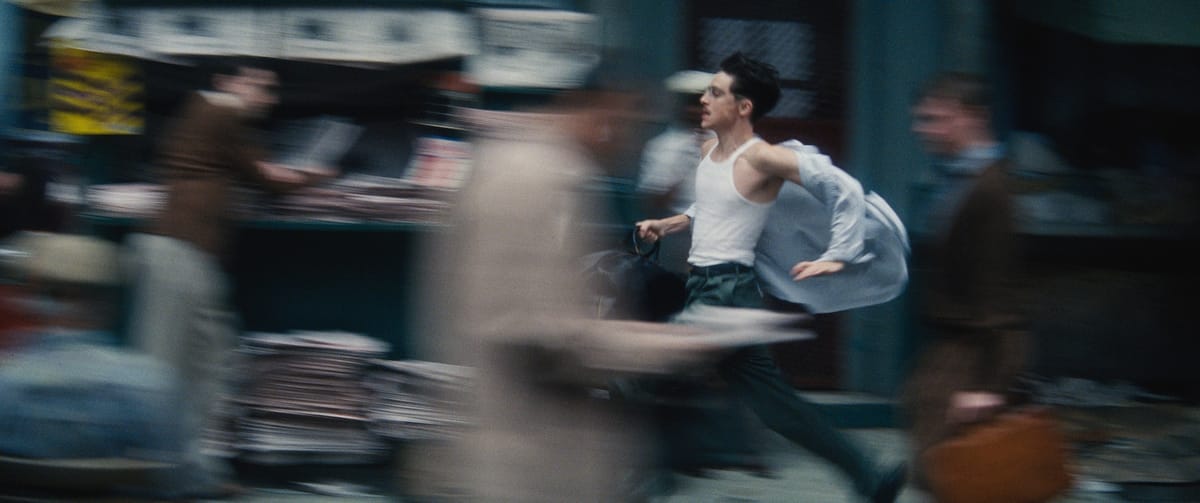
One of the striking aspects of Marty Supreme is how closely it resembles Josh Safdie’s 2019 movie Uncut Gems, which he co-directed with his brother Benny. And yet with just a few tweaks to character motivations and setting, Marty Supreme leaves Uncut Gems in the dust to be a much grander tale of American ambition, Jewish identity, and fearsome independence. Timothée Chalamet gives arguably the best performance of his young career as a man relentlessly driven by his singular focus that it pushes away almost any empathy to make him kind of a noble bastard, repulsive in the way he treats others yet bizarrely admirable in the lengths he’ll go to achieve his dream. And that beautiful dream that leaves an astonishing amount of wreckage in its wake? Becoming table tennis champion of the world.
Set in the early 1950s, Marty Mauser (Chalamet) knows he’s destined for athletic greatness. Having already established himself as the American champion of table tennis (don’t call it “ping pong”), he heads to Europe for the world championship, confident that he will dominate the competition. While there, he breezily racks up a massive hotel bill, woos Kay Stone (Gwyneth Paltrow), a former actor now married to pen magnate Milton Rockwell (Kevin O’Leary), and trounces on anyone who would question his abilities. However, once Marty arrives back home in New York City, his life comes crashing down, and he must make a mad dash for the money he needs to get back in the tournament and defeat Endo (Koto Kawaguchi), his chief rival.
Marty Supreme is a sports drama, but some viewers will probably be surprised how it changes gears after the first act. The film’s first 45 minutes or so focuses heavily on Marty’s table tennis game and how he fashions himself as a champion on par with any athlete. But where the film fully comes alive is how, once he’s back in New York, backs Marty, like Uncut Gems’ Howard Ratner (Adam Sandler), into a corner and sees how he endeavors to claw his way out. There are glaring similarities between the two characters, not only in how they’re overtly New York Jews, but their relentless drive to achieve glory whether they must beg, borrow, or steal to get it. This framing is consciously against the anti-Semitic trope of Jews as aloof powerbrokers pulling the strings, but rather as scrappers, fighting through societies where they’ll always be deemed outsiders. And yet, changing the protagonist’s goal to table tennis champion as opposed to degenerate gambler seeking to make his parlay gives Marty Supreme an odd charm. There’s something so inoffensive about table tennis that Marty Supreme thrives on the juxtaposition of the lengths Marty will go to be seen as the champion of a game that children play in their fathers’ rec rooms.
Furthermore, by pushing the action beyond table tennis, Safdie and co-writer Ronald Bronstein can expand the canvas of the story to almost epic proportions, weaving a tale of uniquely American grit and what it means to truly hold power. As much as Marty knows he’s the best at his particular game, he’s still subject to the whims of people who hold greater power whether it’s the snooty table tennis officials who refuse to recognize his prestige, mobsters who will take what they want by force, his own family that wish to entrap him into a life of shoe sales, or Milton, who can only see Marty as a pawn in some larger business endeavor. Marty’s world is one where generosity is actively withheld, and you have no choice but to power forward if you wish to achieve your dreams. Safdie’s skill is in holding this bizarrely admirable drive at the same time as noting how much damage Marty causes to those around him such as his friends Rachel (Odessa A’zion), Wally (Tyler Okonma), and Dion (Luke Manley).
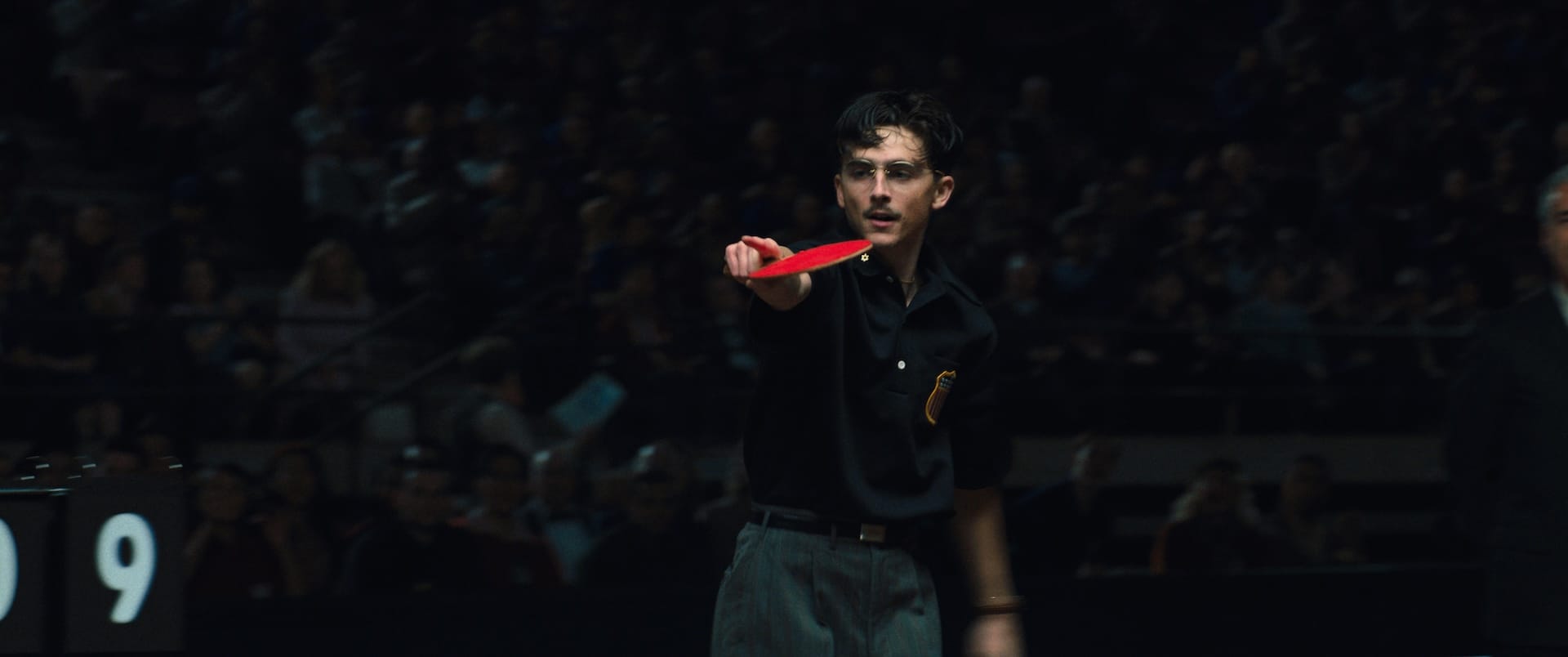
The core question in Marty Supreme is how much selfishness is required for success? You can feel the intent in the casting when Safdie fills out supporting roles with public businessmen like O’Leary as well as John Catsimatidis. We also have provocative artists in the film, whether it’s Abel Ferrara as a criminal who crosses paths with Marty or even a cameo appearance from David Mamet as a stage director. These recurring figures seek to remind us that in America, as much as we profess to uphold moral behavior, what we really value are those who standout within their spheres of influence. American individualism requires distinction, and distinction has no patience for making others comfortable. Marty is both a product and a reflection of the America that causes him to run roughshod over those closest to him.
In lesser hands, Marty could easily come off as an amoral thug, a cocky hotshot whose only path at redemption is through humility. Instead, Chalamet gives one of the finest performances of the year, and one that puts his heavily acclaimed turn as Bob Dylan in A Complete Unknown to shame. It’s not just slapping a unibrow on his handsome features, but how much Chalamet is able to balance Marty’s swagger against his sweaty desperation. He’s Wile E. Coyote, fully running off the cliff, and the only way to defy gravity is to not look down. The fact that Chalamet, even in the depths of Marty’s depravity, can still find notes of sympathy, charm, and vulnerability speaks to why he’s unquestionably one of our finest actors. I don’t know if the Hollywood system as it stands can ever find him a blockbuster not based on pre-existing IP, but it cannot deny him these kinds of roles that showcase him as one of the fiercest forces on screen.
With Chalamet blazing a trail through the story, it feels like everyone around him needs to up their game and force you to reevaluate what they could be. Kay is unquestionably Paltrow’s finest performance in over twenty years and makes you wish she would leave the woo-woo wellness nonsense behind. Kevin O’Leary, otherwise known as Mr. Wonderful from Shark Tank, has one of the best, funniest moments I’ve seen in a movie in years. It’s a movie that even finds a place for George Gervin, cited as one of the greatest basketball players of all-time, and yet it doesn’t feel like a stunt (a friend of mine needed to point out Gervin’s appearance since I have scant knowledge of NBA history). There are no small roles here as the electricity of Chalamet’s performance infuses everyone around him to give the film so much energy that it threatens to explode.
The exhaustive power is particularly acute as Safdie and Bronstein pile on complications for Marty to the point where the film, which runs almost two-and-a-half hours, has trouble holding onto all the characters’ miseries. There comes a point where it feels like the script is throwing curveballs for the sake of throwing them, and while that does lead to new drama, it’s ultimately too much spin on the ball, and you need the movie to rein itself back in a bit. However, despite the dizzying mayhem, Safdie cleverly makes his film feel all-encompassing beyond its mid-century setting. A film released in the 2020s that uses music from the 1980s to tell a story in the 1950s is one that is holding a vastness of ideas matched only by its protagonist’s bravado.
Thankfully, by the time the movie reaches its crescendo, we’re still fully invested in Marty’s bizarre journey and how the stakes of his table tennis game reflect the America we’ve seen unfold over the story—one where domination rather than cooperation is the order of the day. Much like Marty’s personality, it’s a bristling yet captivating depiction of American greatness even if it’s all in service of bouncing a tiny plastic ball across a miniature tennis court.
Marty Supreme opens in theaters on December 25th. Matt Goldberg is a film critic who lives and works in Atlanta. If you enjoyed this review, check out his newsletter Commentary Track.
Stuff David Chen Has Made
David Chen here. It's been a wild time as I've tried to make the transition to living in Portugal while still maintaining all my podcast commitments along with this newsletter (not to mention keeping up with the deluge of awards season screeners). After a month in, I'm slowly starting to get the hang of things. I hope to produce some some written coverage of end-of-year films soon. With that said, here are a few things I've made recently:
- Over on Decoding TV, Patrick Klepek and I are covering Pluribus week to week. It's been a pleasure to interact with listeners/fans and hear their wild theories on what's going on in this thought-provoking show. Check out our review of the latest episode below, and subscribe to the (free) Decoding TV newsletter to get Matt's written recaps.
- On Dave Chen Travels, I made a vlog showcasing some of the beauty I've been able to experience in Portugal so far.
- On the Filmcast, we were a bit disappointed in Wicked: For Good. Part One just set a really high bar!