Darren Aronofsky’s AI Slop Is a Betrayal of Everything His Movies Stand For
For a director whose films leaned into raw humanity and stressed an environmental message, his latest effort is a crushing disappointment.

I cannot overstate how disappointed I am with Darren Aronofsky. The Fountain is one of my all-time favorite movies. Black Swan and The Wrestler are extraordinary films about destroying your physical body to make art because you can’t conceive of your identity without that destruction. Noah and mother! are intense works of an atheist using Judeo-Christian stories to stress the importance of protecting our planet. And yet it almost seems like, although he is unaware of my existence, he somehow keeps humiliating me. As I was standing in line to see mother! at the Toronto International Film Festival, I was chatting with a friend who criticized Aronofsky as pretentious. “He’s not pretentious!” I argued back, trying to point out the substance of his movies. Then as we walked into the theater, we were handed a poem printed on heavy card stock. Okay, so maybe alittle pretentious.
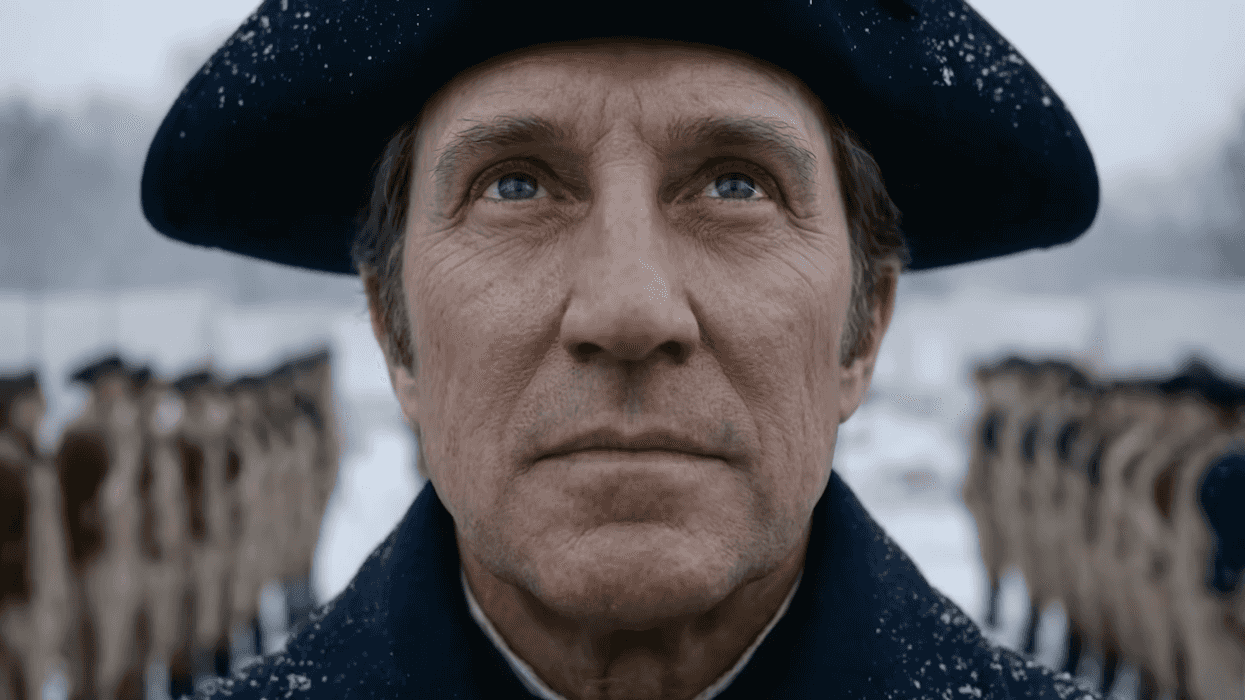
But that transgression pales in comparison to how far off the deep end he’s gone with his embrace of generative AI. He announced his interest and partnership with Google’s AI-focused subsidiary DeepMind in May 2025, and earlier this week we got a glimpse of what that will look like with the upcoming On This Day…1776. The trailer and first two episodes of the web series are now available via TIME Studio's YouTube page. The press release tries to stress that this is a collaboration with GenAI rather than a 100% AI product: "Grounded in historical records, the series is animated by artists using a variety of generative AI tools, voiced by SAG actors, with an original score; and edited, mixed, and color graded by our post-production team."
For his part, Aronofsky simply sees GenAI as a tool in the toolbox. "Filmmaking has always been driven by technology,” Aronofsky said in a statement [via the LA Times] that referenced film tech pioneers the Lumiere brothers and Thomas Edison. “Today is no different. Now is the moment to explore these new tools and shape them for the future of storytelling.”
Setting aside that previous technological advancements A) required people to handle the controls at every stage; and B) weren't 100% reliant on theft of previous art, you can see this looks like hot garbage:
Does it look slightly better than your usual AI slop? Sure, but it’s AI slop all the same. As others have pointed out, it still has the same weird hallucinations and errors that GenAI produces such as the guy throwing up a tri-corner hat only to show he is wearing a smaller hat underneath (an A+ joke if someone intended it, but since it’s someone in the background probably not!). It also has the overly polished look of all AI video where everything is strangely immaculate and impersonal. And that’s going to happen when you ask the computer to make you something and bypass real artisans.
Consider Ken Burns’ recent docuseries about the Revolutionary War and the painstaking effort that was required to construct such a work. And even if that series was bad, it would still be the work of real people who toiled away on a real project. Aronofsky forces us to ask, “Why should I watch something made by nobody?” He knows how hard it is to make movies and TV shows. He knows conversations with art departments and costume designers and actors to forge a single vision. I was on the set of Noah for a scene where people are trying to fight their way onto the ark, and the director played Guns N’ Roses’ “Welcome to the Jungle” to hype the extras up as they charged through the most sprinklers ever used for a rain scene in a major Hollywood movie. It was exhilarating and it respected the work of everyone involved.
This new work lacks any respect, and while there are some directors who wouldn’t surprise me if they embraced GenAI, the technology is a stunning rebuttal of the themes that supposedly powered Aronofsky’s previous work. In Black Swan, we see Nina’s bleeding toes and deteriorating sanity as she pursues balletic greatness in performing Swan Lake. In The Wrestler, we see the emotional and physical toll on Randy “The Ram” Robinson as he gives everything he has to the ring. Aronofsky wants us to consider not only the cost of this greatness, but its dark beauty, and how people will give everything they have to something they love. For Aronofsky, self-destruction can be intertwined with beautiful transformation. His films caught on with people because they recognized the flawed humanity in them. Even Requiem for a Dream, a film that’s deeply difficult to watch as his main characters lose themselves to drug addiction, connects because it recognizes the flawed, aching humanity that powers the addiction.
What is the perspective of On This Day? Where is the craft or care or point of view? Everything you cede over to the computer may save time and money, but it also eliminates artistry. Aronofsky isn’t making choices here as much as he and his team are feeding a prompt into a computer and the computer, based on art it stole from others, tries to come up with a reasonable answer. There may be refinements in prompts and minor tweaks, but it’s, at best, an embrace of the highly derivative from someone who made his reputation on controversial, incendiary art.
This doesn’t even get into the environmental costs of AI. If you're trying to portray GenAI as useful, that then becomes a selling point for Google and other tech companies to gobble up more land for data centers, require more energy for powering servers, and more water for cooling those servers down. I’m willing to accept that Aronofsky may have mixed feelings about humanity, but both Noah and mother! felt like desperate pleas for the conservation of our natual resources. He produced the 2022 documentary The Territory about the indigenous Uru-eu-wau-wau people of the Amazon fighting back against farmers, colonizers, and settlers. Does this tribe now need to get out of the way if Google wants to build a data center on their homeland?
What Aronofsky has apparently missed with his use of GenAI is that the materials themselves tell a story. He’s not merely experimenting privately with these tools, but believing this is good enough to publicly transmit throughout the year to mark the 250th anniversary of the signing of the Declaration of Independence. The story he’s telling is not one of our current technology conveying American mythos, but one of a lazy storyteller turning his back on the ideas that made him a noteworthy artist in the first place. Those behind On This Day may want to conflate the revolutionary ideas of the founders with the “revolutionary” concept of GenAI, but there have been and always will be hacks. It’s just sad that Aronofsky is now happy to count himself among them.