Does Anybody Want This? AI Fights, Fantasies and Fictions
It is, once again, joever.
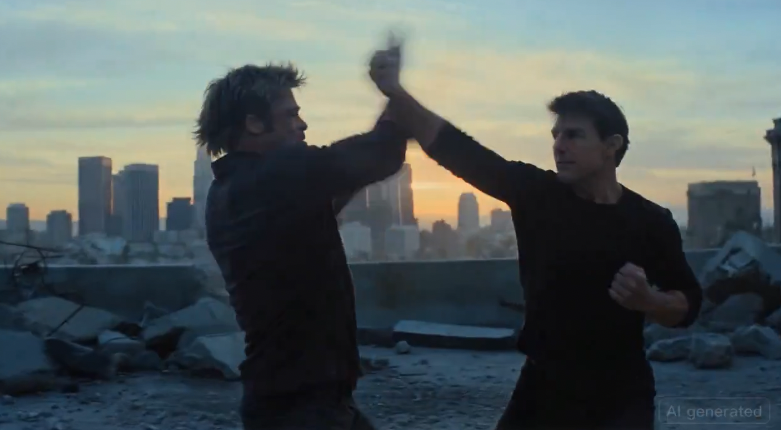
A viral 15-second clip of an AI generated fight between Tom Cruise and Brad Pitt has “spooked Hollywood”, spurred Disney to legal action and had Deadpool screenwriter Rhett Reese warning “it’s likely over for us.” Creator Ruairi Robinson claims to have generated it with a two line prompt in Seedance 2.0, showing off the new AI model’s key features like visual consistency across cuts and synched audio and visuals.
But while I am hesitant to say that on the contrary, we are actually so back, a few words before Hollywood's funeral. One, there is good reason to doubt whether the clip is as groundbreaking as it seems - Shokunin makes a convincing argument that rather than completely AI-generated, the Pitt/Cruise Bruise Cruise is more likely a combination of face & background replacements of greenscreen reference footage. That's not to say AI wasn't used, especially for the face replacements, but it's far less of a feat than a complete AI-Generation – it's the difference between a magic trick and actual magic. There's an awful lot of human mediation involved in the version of the clip's production proposed by Sokunin, which I'm inclined to agree with. It's also worth mentioning that Ruairi Robinson, who first posted the fight, is a filmmaker and frequent AI experimenter whose previous work includes AI-generated footage of anti-AI protesters setting the streets ablaze, and a rave pop music video based on Rudyward Kipling’s Boots.
But regardless of whether or not this specific video was completely or only partially AI-Generated, the exponential increases in the quality of AI-Generated videos, text and music over the past few years is undeniable. The warnings to the entertainment industry are dire – we're washed, and cooked, perhaps even unc. But beneath all of that is a more fundamental question: is AI-Generated entertainment actually something people want?
No technology has ever evoked the words “brackets derogatory” like Artificial Intelligence. To say something seems AI-generated is, in almost every context, a negative: it evokes a generic, meaningless copy. An email, CV or Hinge message that feels AI-generated instantly suggests a lack of effort from its creator. A picture that looks AI-generated is immediately scrutinised closer for the tells of fake-ness, like some kind of folklore trickster fae with too many fingers. And when the Stranger Things finale didn’t live up to the hype for some viewers, “AI-generated scripts” was the insult people reached for (which wasn’t helped by a glimpse of an open ChatGPT tab in a behind the scenes documentary.)
Even the most evangelical articles on the coming AI entertainment revolution have to admit that uptake is slow and audience reactions aren’t great. THR’s writeup on an AI Podcast Start-up was full of impressive sounding numbers that, when broken down, translated to around 30-50 streams per algorithmically created episode. The NYT’s latest AI piece about the technology’s infiltration of romance writing had to acknowledge that while romance was seen as an easy genre to replicate given its heavy use of tropes, romance readers have reacted violently against AI generated books. It’s not surprising - human connection is at the core of the romance genre, and a large language model will never love, yearn, or get railed in a sundress. Even relatively small uses of AI, like in The Brutalist or Civil War, hang over the films like a bad smell.
So why has the entertainment industry been so keen to introduce and normalise a technology that most people don’t actually like?
Artificial Introduction
AI’s introduction into workplaces has been divisive —a recent paper from the National Bureau of Economic Research found that while nearly three quarters of the firms they studied had actively adopted AI, in 80% of cases it had no impact on productivity or employment. Other, in-progress research from the Harvard Business Review concluded that AI intensifies workloads and leads to a perceived burst of productivity that looks good in the short-term, but is unsustainable and needs guardrails. Even in their largely AI-friendly research, HBR found that at the tech company they studied, workers using AI had a habit of leaving their area of expertise, relying on Gen AI to plug their knowledge gaps, but the buck stopped with the company’s engineers, who were left to correct others’ AI-enabled mistakes. In other words, the marketing team could vibe-code all they liked and feel like they were helping, but there had to be a human safeguard at the end of the process, watching out to correct the machine’s confident mistakes.
AI's introduction into entertainment has followed a similar path — C-suite executives and decision-makers pushing it, and a perceived burst of productivity that requires an actual human to make sense of it. GenAI scripts need a human to rewrite them, algorithmically generated VFX must be tweaked, AI-Generated costume designs are often un-sewable. The appeal of AI to the business side of entertainment is obvious — it cuts costs (for now) and gets rid of pesky artists (for now) who have human demands like “quality”, “integrity” and “food”. And after all, the creative process has always been built on influences — as the oft misattributed quote goes, good artists copy, great artists steal.
But a creative influence is only a starting point – a prompt is an endpoint, an order. A human can take an idea forward but an AI can only fulfill the request. The idea has to be provided by a human. The growth market of AI driven prompt-generators is its own punchline, a tool for those so bereft of creativity that they need the computer to tell them what to tell the computer to make, but the real problem with AI’s sneaking growth into film and television and other entertainment isn’t just the erasure of human creativity. It’s the erasure of the human audience.
The Ghost Outside The Machine
Perhaps it’s fitting that, in the rush to remove human artists from the equation, AI boosters would also forget the human at the end of the process. But without an audience, entertainment is pointless — it exists for no one, and if there is no one making it, who is it for?
Entertainment is one of the oldest forms of human communication — as long as we’ve been able to speak, we’ve been making shit up and passing it on. Elizabeth Fisher’s Carrier Bag Theory of evolution proposed that the first human tool was not a weapon, but a bag to store and carry what we gathered, and Ursula Le Guin took this theory and ran with it, arguing that stories were bags too: “a book holds words. Words hold things. They bear meanings. A novel is a medicine bundle, holding things in a particular, powerful relation to one another and to us.”
What is an AI-generated story, or film, or song, under that paradigm? Can words still hold power if they’re assembled without conscious intention, but by statistical probabilities? I believe they can, brackets derogatory – AI optimist and Avengers: Endgame co-director Joe Russo promised in April 2023 that fully AI film production was only two years away, and that soon “You could walk into your house and [say to] the AI on your streaming platform. ‘Hey, I want a movie starring my photoreal avatar and Marilyn Monroe’s photoreal avatar. I want it to be a rom-com because I’ve had a rough day,’ and it renders a very competent story with dialogue that mimics your voice, and suddenly now you have a rom-com starring you that’s 90 minutes long.”
If humans started telling stories to share experiences and knowledge, what is being shared here? An algorithmically produced pixel-slurry of you and a long-dead screen icon whose image was exploited against her will, both before and after her death, created for you at your own request. It is not entertainment as communication, and it is not an exercise in creativity, it is gazing so hard at your navel you disappear up your own asshole.
Luckily, we don’t have to think too hard about the moral and ethical implications of this hypothetical technology because more than two years after Russo’s prediction, the longest consumer-level AI platform limits videos at two minutes. The power balance of AI entertainment is also going in the opposite direction to Russo’s predictions: instead of user-driven AI entertainment delivering your personal rom-com, AI is being fed to mass-audiences, slipped in to cut costs and hopefully go unnoticed. The audience have become the same type of backstop as the engineers in the HBR’s study – entertainment companies vibe code and feel productive about their high output, and the audience are left to pick through what is thrown at them for anything worth keeping, that actually has meaning, among the firehose of content.
In the previously mentioned NYT article on AI books, AI-optimisation-course-seller Coral Hart taunted that “If I can generate a book in a day, and you need six months to write a book, who’s going to win the race?”. Reporter Alexandra Alter dutifully noted that while she was speaking to Hart, Hart’s laptop AI generated a novel in 45 minutes, but for some reason she didn't ask the obvious question – why would I spend longer reading a book than you took to write it? Why would I read something you couldn't even be bothered to write?
The core promise of AI is perfection without effort. A technology to plug our knowledge gaps and allow people who can’t code to vibe-code, and people who can’t draw to generate Ghibli art, and people who can’t play music to prompt their own “Blonde Pop-Country Princess Heartbreak” songs (Suno AI, the leading music AI, doesn’t allow artists as direct prompts, but you can get around it). Ability without effort is an alluring promise, because effort sucks. Why write a book when you already know everything that's going to happen in it? Get the AI to write it and now you can sell it.
That’s not to say it takes no time or effort to prompt AI models to produce specific outcomes – there are thousands of guides to get the best results out of specific platforms, how to skate the limits of content or copyright restrictions. But in getting AI to generate your short film, or bodice ripper, or fashion design, you don’t actually learn how to make anything, only how to coax a program into making it for you. You learn a skill, but not the skill.
And AI cannot learn the skill either because it's incapable of learning – it might be able to copy other people’s homework and make something distracting, even entertaining, but it will never be able to create something truly new. It will never have something to say, because it fundamentally does not know what it’s saying.
And all of this uncovers something far sadder in the promise of AI's instant perfection – isolation. Reacting to the AI Pitt Cruise fight, Rhett Reese theorised that:
In next to no time, one person is going to be able to sit at a computer and create a movie indistinguishable from what Hollywood now releases. True, if that person is no good, it will suck. But if that person possesses Christopher Nolan’s talent and taste (and someone like that will rapidly come along), it will be tremendous.
But Christopher Nolan doesn't make films alone. Filmmaking is a fundamentally collaborative medium – a film is too large a project to make by oneself, and in collaborating and stress-testing an idea, it gets better. If you travelled back in time and gave young Christopher Nolan an AI capable of executing his every, hyper-specific direction, then you still don't get a Christopher Nolan film because there's no Emma Thomas, no Jonathon Nolan, no Wally Pfister or Hoyt Van Hoytema or Nathan Crowley or Ruth De Jong or Jennifer Lame. What you get is the Christopher Nolan equivalent of the Russo RomCom Marilyn Matrix, and a complete elimination of every human – collaborator, teacher, audience, friends – all replaced with content, just for you.
Does anybody want this?