Disney Has Forgotten That Animation Can Do What Live-Action Can’t
The live-action ‘Moana’ remake proves realism is overrated.

Today, I'm pleased to share a piece by Caroline Siede about the folly of Disney's live-action remakes. It's the first of what I hope will be many pieces by Caroline and Matt Goldberg (and hopefully others!) as we ramp up our coverage of movies and pop culture this summer. Please join me in welcoming Caroline to Decoding Everything. -David Chen
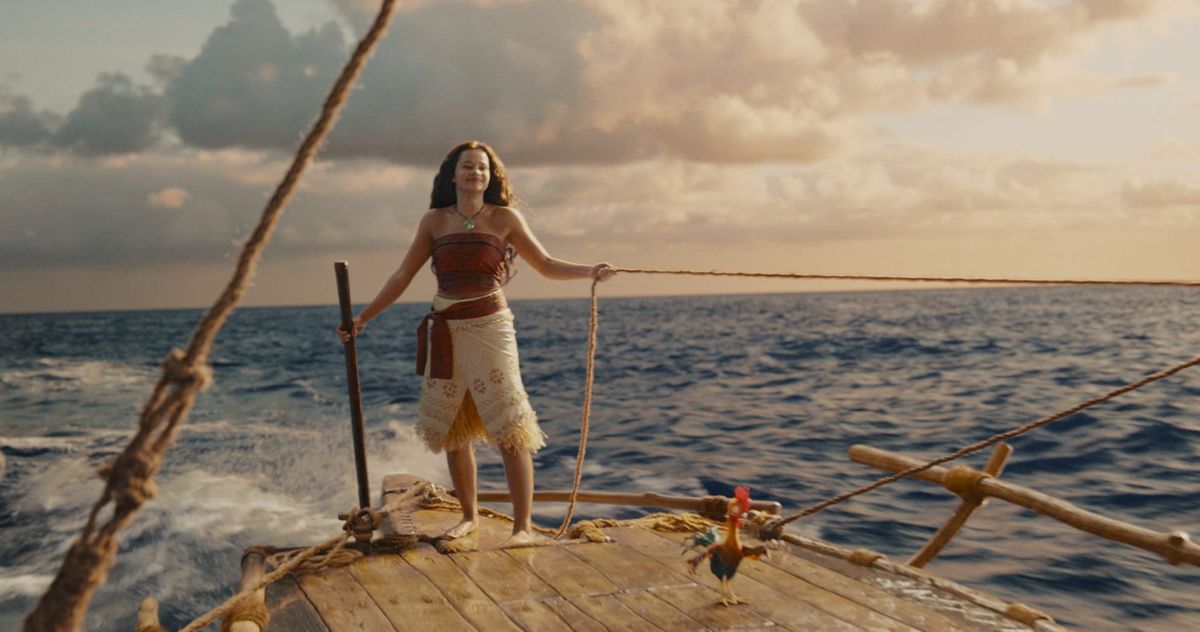
With the new live-action Moana hovering below 40% on Rotten Tomatoes and potentially poised for box office disaster, the problem seems obvious: Disney took a gorgeously animated ode to mythic ocean adventure and turned it into an ugly, poorly lit, lifeless, too-soon remake. But the issue with the new Moana extends far beyond its uncanny blend of human actors and CGI backdrops. In fact, it’s something that’s plagued all these live-action remakes in one form or another. Despite Disney’s insistence on trying, you can’t just transpose the medium of animation directly into live-action and expect it to hit the same, any more than you can string together three random episodes of TV and expect it to be an effective movie. Different mediums require different approaches and that’s something Disney has weirdly forgotten—even though the studio literally pioneered animated features as we know them today.
In fact, there’s no medium that can take you on an emotional journey quite as efficiently as animation. Take the “A Whole New World” sequence in Disney’s 1992 classic, Aladdin. Across a little over two minutes, we watch Princess Jasmine jolt with surprise as she takes to the sky on a magic carpet; share a reassuring wave to her worried tiger friend below; slowly learn to trust Aladdin’s flying skills; soften as he hands her a flower; give in to the rollercoaster thrills of her magical ride; engage in some madcap Egyptian comedy; piece together the fact that Aladdin is secretly the “street rat” she met in the marketplace earlier; and realize that she’s falling in love with him.
Even taking the lyrics out of the equation, the visual storytelling alone conveys an entire emotional journey about discovery, adventure, trust, and romance. Jasmine is a different person when those two minutes end than she was when they started—someone freer, happier, and more trusting than she was before. Just the way she smirks at “Prince Ali” as he tosses her an apple tells us everything we need to know about their dynamic. She’s onto his act and charmed by it anyway.
Compare all that to the “A Whole New World” sequence from Guy Ritchie’s 2019 live-action Aladdin remake. The song runs the exact same length and even recreates some of the shots of the animated version, but there’s no arc there. While Ritchie vaguely conveys a broad sense of wonder and flirtation, all the character-based specificity is lost. The “realism” of what it would look like for two people to actually sit on a flying carpet subsumes all the little interactions and close-ups that make the original feel like an emotional journey in addition to a magical ride. It’s not that the actors are doing a bad job, it’s that they’re working in a medium their director is refusing to adjust for.
All of that was on my mind as I watched Thomas Kail’s new Moana, which is the most direct beat-for-beat remake Disney has delivered since the “live-action” Lion King. Though Moana is at least more charming than that Jon Favreau abomination, it suffers from many of the same problems—namely the misguided idea that redoing an iconic sequence with more realism adds something to the mix when, in truth, all it does is subtract from what animation does best.
It's ironic because, from the beginning, Disney has understood that the power of animation is that it isn’t fully beholden to realism. The studio’s first animated feature, 1937’s Snow White and the Seven Dwarfs, blends the relatively grounded designs of Snow White and her prince with the goofy comedic look of the dwarfs and the campy theatrics of the Evil Queen. To ensure their hand-drawn worlds still felt cohesive, a group of Disney animators lovingly known as the “Nine Old Men” came up with twelve basic principles of animation—guidelines on how to convey a feeling of reality in stories that aren’t aiming for realistic depictions of the world.
To give a sense of weight, characters need to “squash and stretch” when they move, like animated Maui so often does. There needs to be a sense of anticipation before each movement and a lingering sense of momentum afterwards, like when animated Moana whips around and her own hair hits her in the face. And characters need to be defined by strong “golden poses” in between the more fluid action shots, like Moana leaning on her oar or holding onto a mast. If you pause a Disney animated movie at a random moment, the characters often look over-the-top or weirdly proportioned. (One of the twelve principles is literally “exaggeration.”) But, in motion, all that attention to microexpressions and character-based movement conveys a huge sense of feeling in a very short amount of time. That’s what animation does best.
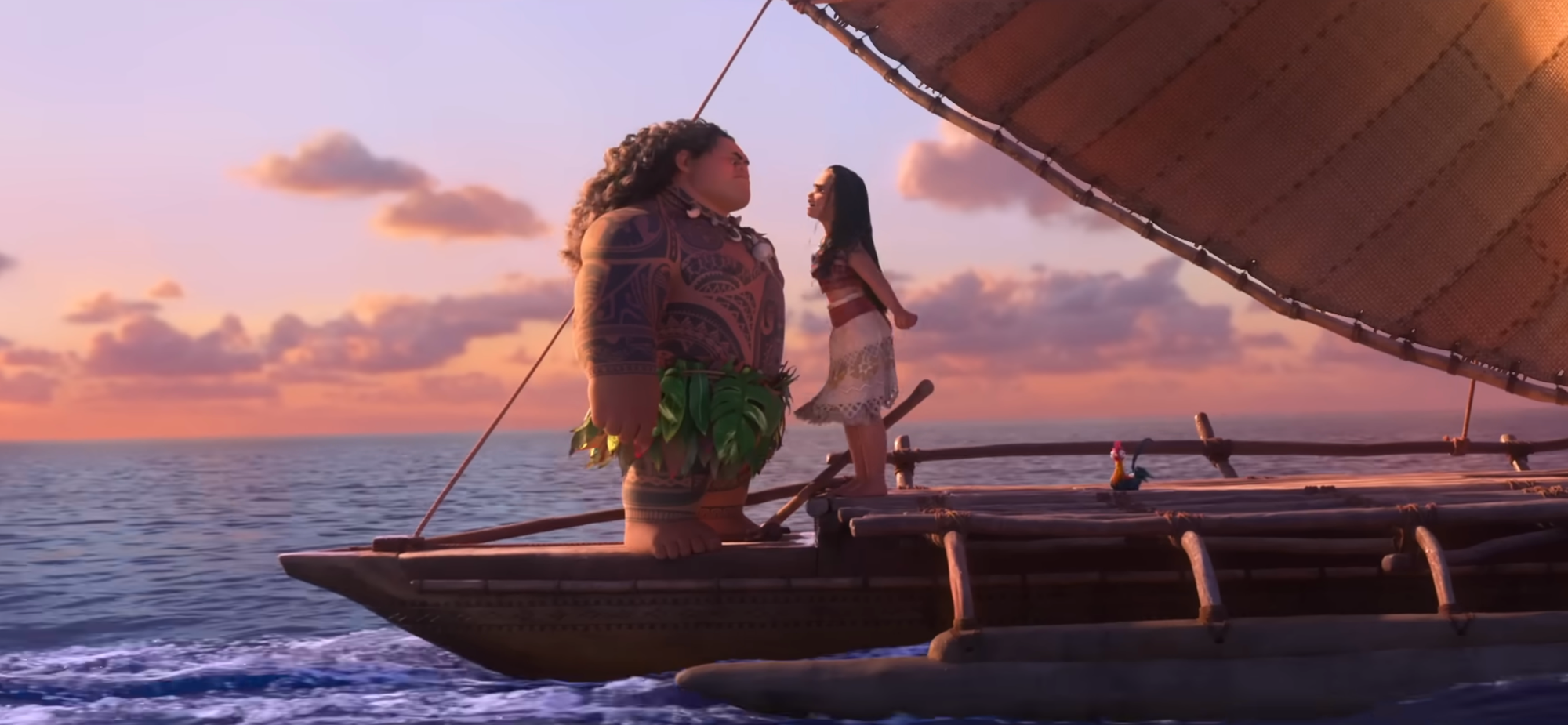
Those principles don’t translate into live-action, however. When Catherine Laga'aia strikes one of Moana’s signature poses it feels artificial because that’s not how real people behave. Yet when the movie sticks to realism, it loses a lot of the original’s whimsy too. In the animated version, there’s so much character building to the way teeny tiny baby Moana toddles down to the beach to first meet the anthropomorphized ocean, who playfully swirls her hair into an updo. Since there’s no way to replicate that with a real human child, the live-action version trims it, losing the magic of Moana’s friendship with the ocean in the process.
There are compromises like that all over the new Moana. While The Rock can admittedly do a lot with a cocked eyebrow, in real life there’s no way to replicate the relationship-building physical comedy of giant Maui picking up Moana by her head and plopping her around. While the quick furrowing of animated Moana’s brow in “Where You Are” tells us everything we need to know about the doubt she feels about her future, that doesn’t translate in live-action—not least of all because human faces don’t move as dramatically as animated ones can. There’s also the fact that the pacing of songs written for animation leaves too little room for the slower, more realistic expressions of real-life people. Tellingly, when the Broadway version of Aladdin stages “A Whole New World,” the song is extended to be nearly twice as long. Watching two human beings fall for each other in real time needs to unfold at a different pace than it does with two animated characters.
That’s also why the most memorable moments in Disney’s live-action remakes are the ones that aren’t lifted wholesale from the originals. The largely beat-for-beat recreation of the ballroom dance in the live-action Beauty and the Beast totally fails to capture the romance and wonder of the animated version—and not just because Belle’s live-action dress sucks. But the ballroom sequence in the live-action Cinderella absolutely does convey a sense of magic because it completely reimagines the original setpiece.
Instead of leaning into the dreamy, operatic feeling of the “So This Is Love” sequence from the original, director Kenneth Branagh gives his scene the sweeping joy of a romantic comedy. He takes time to focus on his characters smiling at each other and completing each other’s sentences. And he knows when to zoom in on a hand grabbing a waist and when to zoom out on a dress twirling in epic proportions. If you traced the sequence in animation, it would probably feel too slow and literal, but that’s what makes it such a good translation. It feels true to the spirit of the animated version while honoring the needs of the live-action format.
A truly effective Moana remake would similarly need to reimagine the story and its pacing from the ground up, but that would defeat the purpose of Disney reheating its own nachos for maximum nostalgia. That’s the catch-22 these live-action remakes find themselves in. They want to evoke Disney classics without understanding why those classics worked in the first place. Animation isn’t an arbitrary form these beloved stories take, it’s the reason they’re so impactful. Stripping that away is like robbing a demigod of his hook. If this new Moana does flop, maybe it’ll teach Disney that it’s time to go back to the drawing board—and not port it over into live-action this time.
Caroline Siede is a film and TV critic who runs the newsletter Girl Culture.