‘You Can See Everything’s’ Secret Weapon Isn’t Anywhere in the Trailers
Digging into the film’s second half and the ethical questions it purposefully creates.

[This article contains major spoilers about You Can See Everything. If you haven’t seen the movie yet, stop reading and come back afterwards. You can also read my non-spoiler review of the film.]
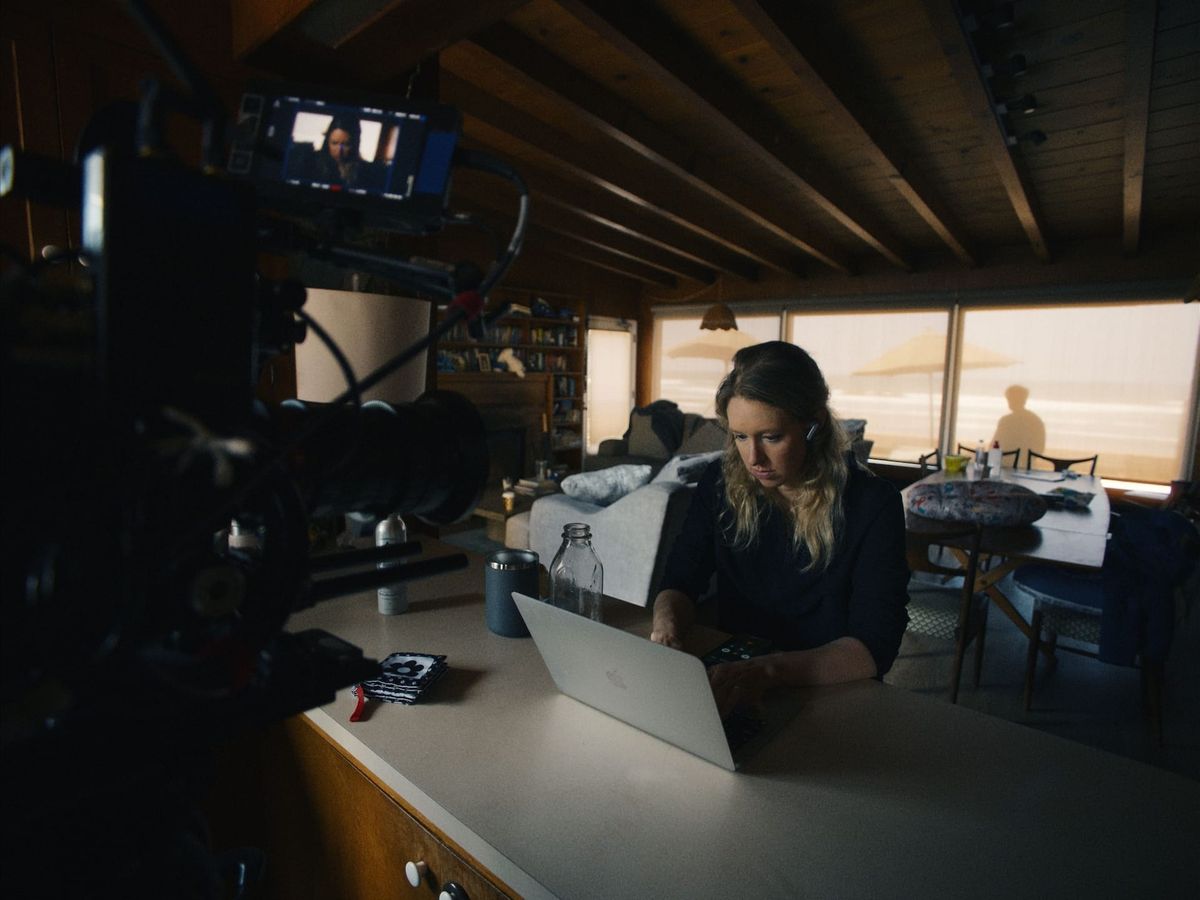
As You Can See Everything arrives at its halfway point, you see Elizabeth Holmes headed into the federal prison where she’ll spend years of her life. At this point, it would seem like the documentary has hit an impossible roadblock. Everything before was Nathan Fielder interviewing Holmes and her partner Billy Evans at their rental home in Del Mar. Once she’s behind bars, and with no way for recording equipment to enter her detention facility in Bryan, Texas, how is there still over an hour left of the documentary? The movie skips forward from 2023 to 2025, where Nathan meets up with Billy again, and Billy, almost defiantly, tells him there’s a less than zero chance he’ll be able to record another interview with Elizabeth while she’s in prison.
Enter…Amanda Seyfried.
Seyfried as Co-Conspirator
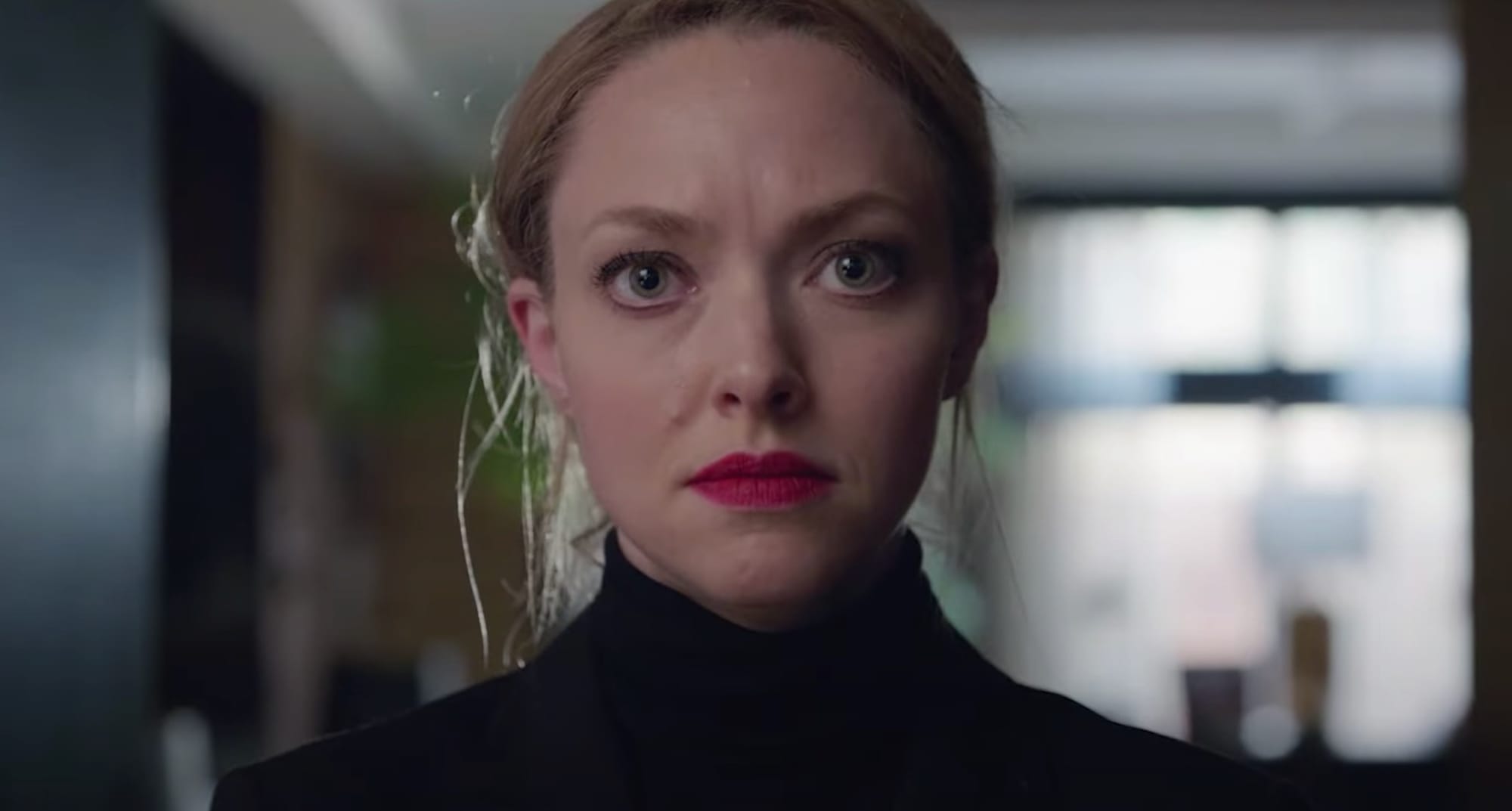
The actor appears previously in the film when Nathan asks Elizabeth and Billy if they’d like to watch The Dropout, the 2022 Hulu series based on the ABC News podcast about Holmes and the rise and fall of her company Theranos. Elizabeth makes it a few episodes into the series, but eventually wants it to be shut off, unable to continue watching Seyfried’s portrayal. It’s a portrayal that looms over the movie since it’s both based on the public perception of Holmes as well as feeding it a new one of her conscious duplicity and transformation.
The Dropout was a major hit, earning several Emmy nominations and a win for Seyfried as Best Actress in a Limited or Anthology Series or Movie. Having watched the series, I think it’s a solid drama that leans into the dark absurdity of Silicon Valley’s mythmaking with great performances across the cast. It’s not the only series handling this kind of story (see also WeCrashed, Super Pumped, or even the upcoming The Altruists), but it’s effective at capturing the ethos that apparently compelled Holmes to rush past whether or not her device worked and play the role of genius inventor. Like most dramas, there is artistic license (Nathan dryly asks Elizabeth, “Did that happen?” when Seyfried-as-Holmes is on screen dancing to Alabama’s “I’m in a Hurry (And Don’t Know Why)” to a poster of Steve Jobs), but that license raises questions about how much a subject has to participate in a drama when they’re also a public figure.
The Seyfried of it all kicks the movie into overdrive, highlighting the ways documentaries are consciously constructed rather than hard realities. You could argue that The Dropout and You Can See Everything are in the same business—trying to get to the truth of Elizabeth Holmes, how she deceived so many powerful people, and if she’s consciously manipulative or purposefully deluded (The Dropout presents Holmes as an ambitious woman whose goals, as well as her relationship with Sunny Balwani, corrupted her and transformed her into an outright villain). Seyfried starts out as audience, then becomes Nathan’s co-conspirator, then returns to the role of Holmes. She exists in the liminal space between someone shocked by what she saw in the first half of the movie, but also reprising a role she created despite Elizabeth’s frustrations with Seyfried’s performance.
Arguably the biggest question hovering over the film is Elizabeth’s performance as Elizabeth. Nathan doesn’t know if she’s merely adopted a new character, similar to how Elizabeth and Billy are working on Theranos 2.0, or if she’s now being real with him. “I’m always being real,” she says to Nathan, to which he responds with no shortage of skepticism. Early in the movie, Elizabeth and Billy take umbrage with a recent New York Times profile quoting Elizabeth as saying, “They’re not playing me. They’re playing a character I created.” They claim what Elizabeth actually said was “They’re playing a character they created,” and they have recordings to prove it (they never provide the evidence, but neither does the Times provide proof that their quote is the real one, although they stand by their reporting). However, Elizabeth and Billy’s claim that the Elizabeth character is one created by the makers of The Dropout and Seyfried does strain credulity. There was no shortage of interviews, videos, and depositions depicting the character Elizabeth sought to portray to the world. Nor is there any shortage of evidence that she defrauded investors and put patient lives in jeopardy through faulty test results. It would be a stretch to say Seyfried’s depiction is constructed from whole cloth.
Furthermore, the “real” Elizabeth is always in question, and even more so in the second half as Billy constructs Elizabeth however he chooses. He licenses her image in support of Ryan “Egypt” El-Hosseiny to promote El-Hosseiny’s project Just Blood. He recreates her in A.I., dismissing the possibility that her deep-faked avatar could be used for pornographic purposes because “people are going to do that anyway.” He uses her Twitter/X account to speak for her in a voice that’s not hers and says things that are demonstrably untrue, like claiming she’s never seen The Dropout. For Nathan, who wants to get at the truth of Holmes’ identity as well as coming to care about her, these actions by Billy only further unravel Elizabeth’s case as acting in good faith and honesty. If the character she created is now out of her control, what hope is there for her even after she’s served her sentence?

And yet Billy and Elizabeth do seem (at least from what Nathan can discern) to love each other. She trusts that Billy has her best interests at heart. None of Billy’s actions (at least as far as what Elizabeth knows, and how much she knows is one of the film’s major question marks) seem to bother her that much, certainly nowhere near as much as Seyfried’s portrayal in The Dropout. People in prison think that Seyfried’s performance is who Elizabeth actually is, and so the real Elizabeth has to deal with the fallout from that. While one could argue the infamy of her scam would have people know her anyway, a popular TV show raises her profile. To put it another way, when Jeffrey Skilling went to prison for the Enron scandal, he wasn’t tied to a movie star playing him in a hit miniseries, so he likely retained some kind of anonymity.
Seyfried, despite appearing genuinely upset at Billy’s treatment of Elizabeth (“We have to break them up!” she exclaims to Nathan at one point) and saying that no woman wants to see another woman treated this way, keeps wanting to portray Holmes even though the real Elizabeth doesn’t like it. This is part of the film’s funhouse inversions where Elizabeth apparently supports a man who uses her image for the crassest, most self-serving means possible, but dislikes someone like Seyfried who is operating based on secondary sources and forming an artistic interpretation. You could argue that on the basest level, Seyfried is also profiting from Elizabeth, but doing so without Elizabeth’s consent.
You can tell Seyfried gets a little defensive every time her motives are questioned directly by Billy or Elizabeth. I would say there’s nothing malicious in The Dropout (even the most unfair portrayal would pale in comparison to Theranos’ actions like telling people they had miscarried or had a disease they didn’t actually have), but when pressed by Billy or reading the transcript of Elizabeth’s comments to Nathan from prison, Seyfried retreats to “It’s TV!” It allows her to have things both ways where she, as an artist and like Nathan, wants to better understand Elizabeth, but can also run to the safety of artistic license if the subject says, “You’re misrepresenting me.” She’s Nathan’s co-conspirator in trying to find out more, but also in raising the question of whether they’re using Elizabeth like everyone else.
The Ethical Issues of Depiction
How can you misrepresent someone known for their dishonesty, and who can’t even seem to be honest with themselves? Elizabeth still doesn’t acknowledge the harms her company caused, maintains her innocence, and thinks this documentary will allow her and Billy to change the popular perception created by a show like The Dropout. Yes, they refuse to approve Seyfried’s performance, but that also speaks to their desire to control everything. For Seyfried, she’s taken aback at how Elizabeth is still a real person, no longer cordoned off by the dictates of The Dropout showrunners. Seyfried’s Elizabeth 2.0 is more human, more beaten down by life. She can say Elizabeth’s words verbatim (or at least as well as Nathan can remember them), but the intonations and expressions come from the actor. You can argue that this time, Seyfried is much closer to Elizabeth than in The Dropout, but there’s always going to be a distance.
The movie is called You Can See Everything, but we struggle to make sense of what we're seeing. The film starting with a list of Holmes’ crimes makes us view her as a criminal, something she refuses to accept. The world says she's a master manipulator and fraud, and she says she’s always been real, but misunderstood. In this way, everyone is engaged in their own form of narrative creation, each one crafted to evoke a particular response. Elizabeth doesn’t want to be known any longer as the woman in the black turtlenecks who scammed her way through Silicon Valley. She wants to be known as the working, disheveled mom toiling away on healthcare technology while raising a family (and perhaps receive a pardon from a guy known for pardoning people who like Charlie Kirk).
In this framing, the real villains are those who would seek to display her in a way that she and Billy don’t intend. Fielder and co-director Lance Oppenheim don't dismiss this outright, and instead meet the argument halfway. To quote Miller’s Crossing, “Nobody knows anybody. Not that well.” Any attempt to depict Holmes will inevitably be distorted, whether it’s in the cuts and shot selection made by Fielder and Oppenheim for their documentary, what Billy provides to those who will pay him, or Seyfried returning to a role that won her an Emmy. Even the construction Elizabeth chose of Silicon Valley entrepreneur, one that exists before meeting Nathan, Lance, Billy, and Amanda, was deceptive. The twisted version that emerges is that Elizabeth and Billy are somehow more honest than artists because they’re the ones telling the story, no matter how full of falsehoods the story may be.
Art is inherently manipulative, and that's where I feel like Nathan, Lance, and Amanda are on firmer ground than Elizabeth and Billy. Nathan even jokes at one point that they should have made Theranos a joke company on Nathan for You as cover. As seen in his “Dumb Starbucks” episode, he knows how to blur the line between legality and performance. Elizabeth and Billy still want people to believe that Theranos can be real to the point where Billy doesn’t want an actual scientist on camera talking to Nathan about the failure of Theranos 1.0. Nathan, Lane, and Amanda know they’re constructing something deceptive and so does the audience, and it’s in service to uncovering a deeper truth about Elizabeth and her knack for duplicity.
The filmmakers can’t remain separate from what Elizabeth and Billy are constructing, whether by perpetuating it or by acting contrary to the wishes of the subject. That’s why the flashback shot near the end of the film of Nathan swimming in the ocean with Elizabeth is so poignant. He had previously erected a boundary—I don’t like going into cold water—but spending time with Elizabeth eventually drew him into the sea. She is no longer the other but, like Amanda, a co-conspirator of sorts. Elizabeth created a character. Nathan, despite his original intentions, created one right back. You can’t swim in these waters without getting wet.
You Can See Everything is now playing in theaters.