‘Whalefall’ Offers Juicy Survival Thrills but Chokes on Attempts at Pathos
Maybe not everything needs to be about trauma.

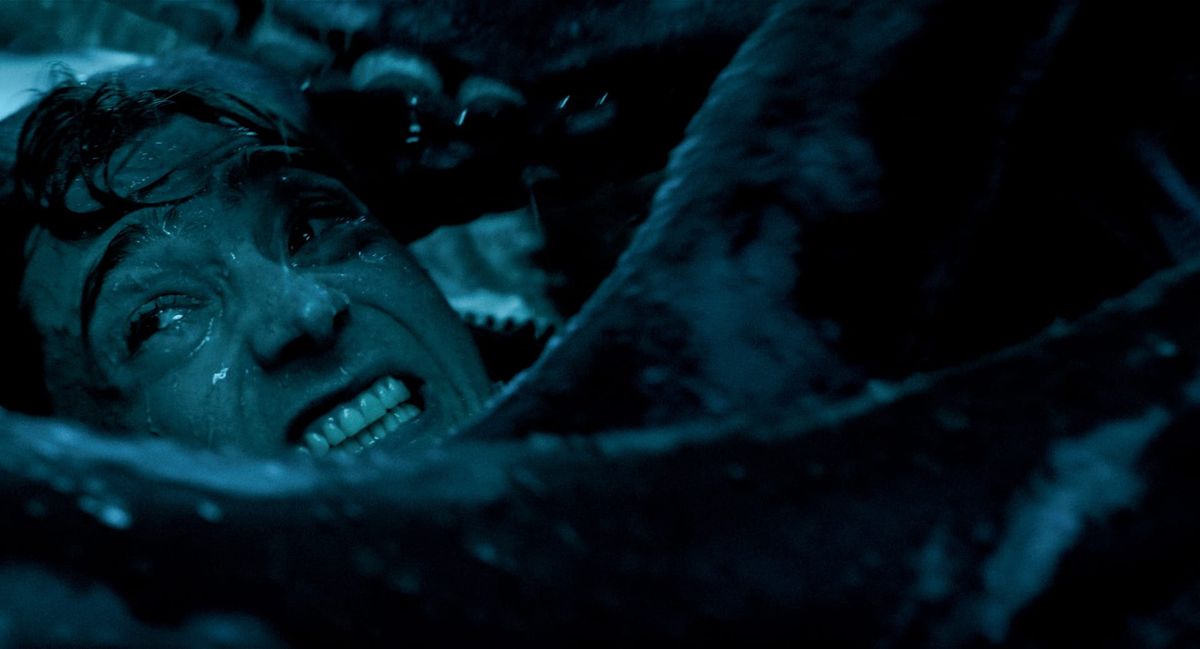
I understand giving stories an emotional core. We’re looking for ways to connect, and when you tap into universal themes like how we relate to our parents, how we deal with grief, the regrets and misunderstandings left behind, then there’s plenty to mine for pathos. But sometimes, that stuff gets in the way of what really matters: getting out of a whale’s tummy. Whalefall is an awkward collision of a pulpy, ludicrous survival thriller and the story of a son trying to make peace with the loss of his deeply flawed father. While there’s some precedent for marrying a whale adventure story with symbolism and metaphor, Brian Duffield’s adaptation of Daniel Kraus’ novel never lands any of its emotional beats, with the characters too thin and the conflict too broad to provide the specificity the catharsis requires. The film is far more effective as a straightforward thriller where a guy is navigating a whale’s guts and the icky, grotesque pleasures such an outlandish scenario provides.
Jay Gardiner (Austin Abrams) is mourning the death of his estranged father, Mitt (Josh Brolin), who committed suicide by drowning after a terminal diagnosis of mesothelioma. A year after his father’s passing, Jay decides to search for his father’s remains by going for a dive. Trained in diving by Mitt, Jay’s search lands him inside the stomach of a whale. With only an hour of oxygen, Jay searches for a way out of the whale while flashing back to the rough times with his father, which also tend to provide bits of knowledge that could help Jay survive his predicament.

We’ve seen a similar survival story with 127 Hours—a man is stuck in one place, and it’s going to be somewhat gnarly if he hopes to survive. But there are some key distinctions, the most important being that 127 Hours actually happened, and Danny Boyle can be an inventive and exhilarating filmmaker when he’s firing on all cylinders. Furthermore, the wandering thoughts of the film’s protagonist feel like real musings, bouncing between fantasies of rescue, imaginings of roads not taken, and memories of family. Whalefall never has that looseness, and instead every flashback merely plays as Jay unlocking some vision of ocean wisdom, which is all that Mitt represents. As good as Brolin is, the script rarely lets him be more than a gruff guy spouting off about the sea to his disinterested son.
What makes the movie come alive isn’t the flashbacks, but Abrams struggling inside the belly of the beast. I’m sure he didn’t intend for this film to follow so closely on the heels of another survival story, last month’s scary and hilarious Resident Evil. Nevertheless, they’re a great showcase for his everyman quality, as well as his talent for holding the screen with the intensity of his performance. Whalefall is arguably the harder job, since he has less room to maneuver. He’s trapped in enclosed spaces, forced into close-ups, and doesn’t speak for large stretches because he’s got a regulator mouthpiece to talk through. Abrams perfectly rides the line of having us root for his character while also relishing his suffering a bit because he’s not trying to be a tough guy gritting through it.
Unfortunately, as the movie heads into its third act, the script loses its thrills and leans hard into trying to achieve a catharsis it hasn’t earned. What we know of Jay and Mitt’s relationship is handled in such a ham-fisted manner that it feels more like a therapy session that happens to be inside a whale (the metaphor of an ocean beast that’s chewing you up is already painfully obvious before the movie takes it even further as if to shout, “Hey, dummies, here’s what the whale means.”) Perhaps if there were more shading to Jay and Mitt beyond their estrangement and the broad strokes of “My dad is a grizzled sailor, and I want to go to college in Iowa,” then these moments might land, but instead it feels like the emotional aspect is a crutch because the filmmakers lack the confidence to fully embrace the weirdness of the premise. While Duffield succeeded in marrying genre thrills with pathos in his debut feature Spontaneous, here it feels like he’s stretching for the movie to be more than it appears, even though the best scenes all lean into the ickiness of the whale’s innards.
It’s weird to say that not every movie needs to be about something, but the use of grief/trauma/regret as some broad thematic umbrella has become so overdone as to lose any hint of originality. Short of Jonah and Pinocchio, not many characters get stuck inside a whale and live to tell the tale. The freshness of the premise becomes stale when the subtext is overdone and handled in such a corny, maudlin fashion as it is here. While I don’t begrudge storytellers trying to find an emotional hook, Whalefall is a case of believing that goofy genre thrills are somehow both too much and not enough. I’d be more than happy watching a guy gutting it out in a whale guts. I don’t need to know how he feels about his dad.
Whalefall opens in theaters on October 16. Matt Goldberg is a film and TV critic who runs the newsletter Commentary Track.