'Mortal Kombat II' Is a Cautionary Tale About Being Too Faithful to the Video Game
David reviews the new 'Mortal Kombat' film

Decoding Everything is a newsletter by David Chen. I’ve been a commentator on movies, TV, tech, and the media for over 15 years. You can support my work by subscribing to this newsletter, sharing about it on social media, or becoming a Patron. Thanks!
The Mortal Kombat video game was an essential part of my childhood.
When I was little, my mom used to take my brother and me to the Pheasant Lane Mall in Nashua, New Hampshire. I remember going to the Dream Machine arcade located in the food court and excitedly inserting $5 bills into the change machine to get quarters. I enjoyed my time with your Virtua Fighters and your Street Fighters. But when Mortal Kombat came onto the scene, it was a different thing entirely.
While players competed in a fighting tournament just like in other fighting games, Mortal Kombat was not a cartoon as those other childish games were. To my younger self, this was an ultra-realistic, gory experience that forced me to confront the inevitable and reality-based outcome of one-on-one fighting: a brutal and bloody death. Bold stuff for an arcade game that I was supposed to play after scarfing down a value meal at Arby's!
I was dazzled by the fantastical world that Kombat conjured, the (at the time) realistic-looking characters, and the whimsical and over-the-top "fatalities" that you could execute against opponents. Creators Ed Boon and John Tobias had an original vision for what this game could be, and it became something that was memorable, strange, forbidden, and occasionally wacky – irresistible for kids like me.
I dipped into the games occasionally over the years, and watched several of the films. But I was particularly impressed by Simon McQuoid's 2021 reboot of the franchise, which borrowed heavily from pre-existing lore. You see, in the universe of Mortal Kombat, Earth belongs to one of many realms that vie for supremacy. When one of these realms wants to conquer another, they compete in a fighting tournament called Mortal Kombat; if one realm can can win 10 tournaments, then the losing realm essentially surrenders.
As Mortal Kombat (2021) kicks off, the realm of Outworld has already defeated Earthrealm nine times in said tournaments (oof). Rather than wait for Earth to get together a viable team for the tenth iteration, an Outworlder named Shang Tsung (Chin Han) decides to start assassinating Earth's fighters pre-emptively. A lot of Kombat (2021) focuses on MMA fighter Cole Young (Lewis Tan) as he not only evades assassination, but grapples with his ancestry and the possibility that he might have a big role to play in the upcoming interdimensional battle.
I enjoyed Kombat (2021) because it was a solid mix of the source material and the typical conventions of a martial arts action film. Cole was a new character invented for the film and thus unburdened by video game fan expectations. He was a decent audience surrogate, reacting appropriately to the wild machinations unfolding around him. And the fight scenes had great choreography with the added twist of showing each character's hidden powers and abilities. Honestly, Mortal Kombat (2021) felt like a decent way for me to introduce the world of this game to action film fans. Here was a movie that was proud of its kinda wacky origins but knew that you still had to have a few conventional plot elements to make the film palatable for the masses.
The end of Kombat (2021) promised something that is core to the franchise: Cole sets out to look for Johnny Cage (one of the most popular characters from the original video game) as Earth prepares to compete in that crucial tenth tournament. And if the sequel ever got made, well, we'd better be prepared for some real Mortal Kombat, tournament-style, just like in the games!
Of course, the sequel did get made and it's out this weekend in theaters everywhere. It does, in fact, deliver the tournament that was promised and bring the Mortal Kombat franchise back to its roots. So what's the problem?
Fighting tournaments are not inherently cinematically interesting.
Fight Club
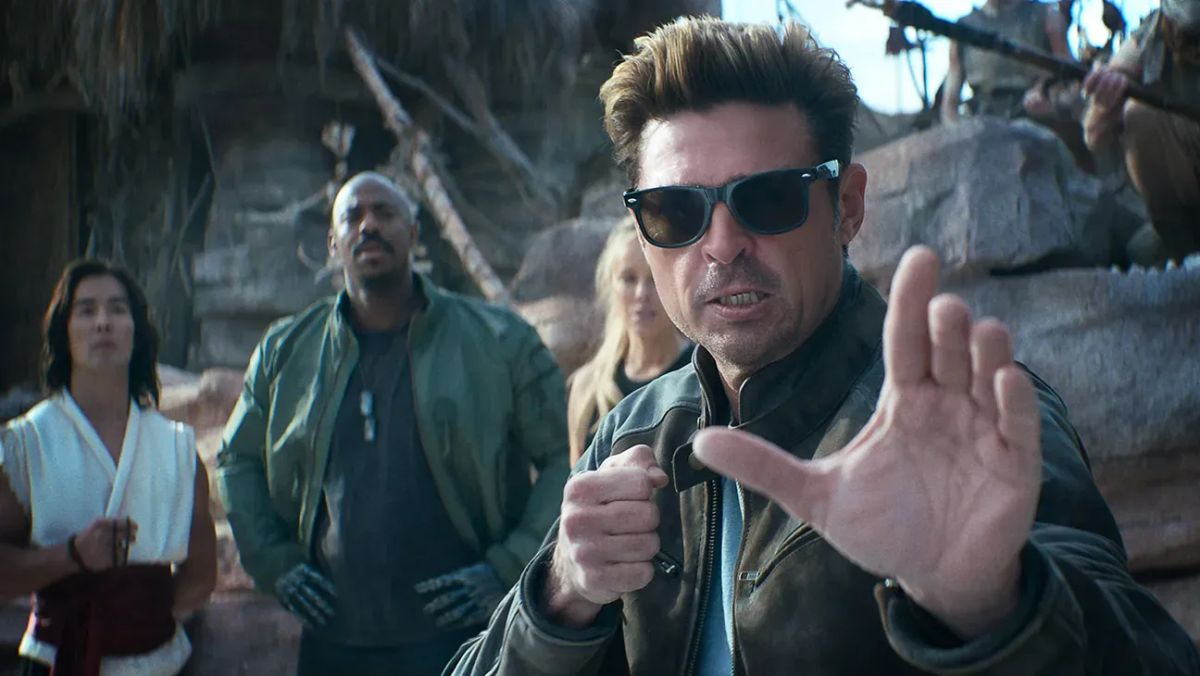
In the prologue for Mortal Kombat II, the evil leader Shao Khan (Martyn Ford) defeats the leader of Edenia and takes his daughter, Katana (Adeline Rudolph), as his own. Khan is set on taking down Earth in the tenth tournament of Mortal Kombat, and he intends to use a powerful amulet to give himself an edge. Meanwhile Cole and his ragtag group of fighters bring in Johnny Cage (Karl Urban), a washed up action movie star, to try and round out their numbers and give them a chance at saving Earthrealm.
Mortal Kombat II proceeds at a blistering pace, shedding character development and conventional notions of pacing in favor of fight fight FIGHT. The film speeds from one fight scene to the next in a structure that's strikingly similar to what it's like to play through a Mortal Kombat video game. I didn't take notes on the film's runtime, but by my estimation, a good 40-50% of the film takes place in fight scenes and when the film is not in a fight scene, the characters are figuring out how to prepare for one.
Maybe this would be fine if the fight scenes themselves were all (or even mostly) remarkable. Instead, they are merely decent. There are a handful of fun action moments and laughs to be had from Urban in full self-deprecating mode as Johnny Cage. But Mortal Kombat II's ambition is so much bigger than its predecessor that its reach often exceeds its grasp. Whereas most scenes in Kombat (2021) took place on Earth or something like it, Mortal Kombat II's battles take place in fantastical locations in different realms, often with drab gray colors dominating the palette. The end result is you're spending a lot of time watching characters duke it out against unconvincing green screen-like backdrops. There are some exceptions to this (a late stage fight with a character who I won't reveal in a desert-like environment was probably the highlight of the film for me). But for the most part, the fight scenes look like this clip below, for good or ill.
Perhaps more importantly, Kombat (2021) had more breathing room for key human moments. In Mortal Kombat II, the film is so preoccupied with hopping from one fight to the next that virtually none of the deaths or defeats land with any emotional impact. The opening few minutes of the first film probably engaged me on a deeper level than anything I saw in Mortal Kombat II.
What's sad is that there are the bones here of a really good action movie. It might be interesting to see how a character like Johnny Cage handles the responsibility of being one of Earthrealm's warriors, or how Cole's feelings have evolved since the first film, or how Sonya and Jax's relationship might be impacted by the events of this one. But Kombat II doesn't spend nearly enough time with any of these plotlines. It's just a series of endless fight scenes. In this way, it's probably one of the most faithful video game adaptations I've ever seen (derogatory).
Having said all that.
The inner-teenager part of me still experiences an unabashed glee from the key-jingling nature of just watching characters I know from the video game make the transition to the big screen. "Whoa, did you see what Liu Kang did with that fire thing?! Wow I can't believe they made Kung Lao's hat do that! OMG it's The Pit, kinda like it was in the game!" I suspect if my younger self had seen this film on the big screen, he would have lost his mind.
And that's ultimately who this movie is for: the video game fans who just want to see the stuff they love from the game in live action form. If you're one such fan, this movie will likely speak to a core part of you that you may not have acknowledged for quite some time. But if you're not, I have to imagine that Mortal Kombat II is going to test you – not your might, but your patience – and leave you wondering what the hell happened to the restrained and competent storytelling from the first film.
Other Stuff Dave Chen Has Made
- Over on my travel channel, I filmed a new vlog about visiting Sintra, one of the most palace-dense cities in all of Europe.
- On Decoding TV, Patrick Klepek and discussed the first episode of Half Man, which is a brutal show to watch.
- Also on Decoding TV, I was grateful to chat with Chris Klimek about the second season of Beef, which I thought was a real mixed bag.
- Also on Decoding TV, I chatted with Patrick Klepek about Widow's Bay, which is one of my favorite new shows of 2026.
- On The Filmcast, we reviewed Steven Soderbergh's The Christophers, which is a fascinating meditation on the nature of art.
- Also on The Filmcast, we had our annual Summer Movie Wager episode, in which we predicted the top films of summer 2026. It was a ton of fun!
- [PAID ONLY] On my personal Patreon, @joyofnapping and I discussed some of the recent adventures we've had in Portugal, plus why some people leave here after trying to make it work in this country.