Hollywood Forgot How to Make Movies Like 'The End of Oak Street'
David Robert Mitchell’s movie sends us back not only to the time of dinosaurs, but to the age of Amblin.

In David Robert Mitchell’s action-adventure The End of Oak Street, we’re walking through the midst of a time that’s never coming back. The present for the characters is 1982, and their suburb is transported back into a prehistoric age of dinosaurs. But the film itself also feels out of time; it’s the Amblin-like adventure where the blockbuster surroundings are cast against a middle-class suburbia and the drama of a family sticking together through outsized circumstances. It’s not based on pre-existing material, nor is it intended to set up a big franchise. It evokes a time when movies could be movies as enjoyable escapist fare. Even as only an imitation of Amblin, that’s far more comforting now than it was just 15 years ago.
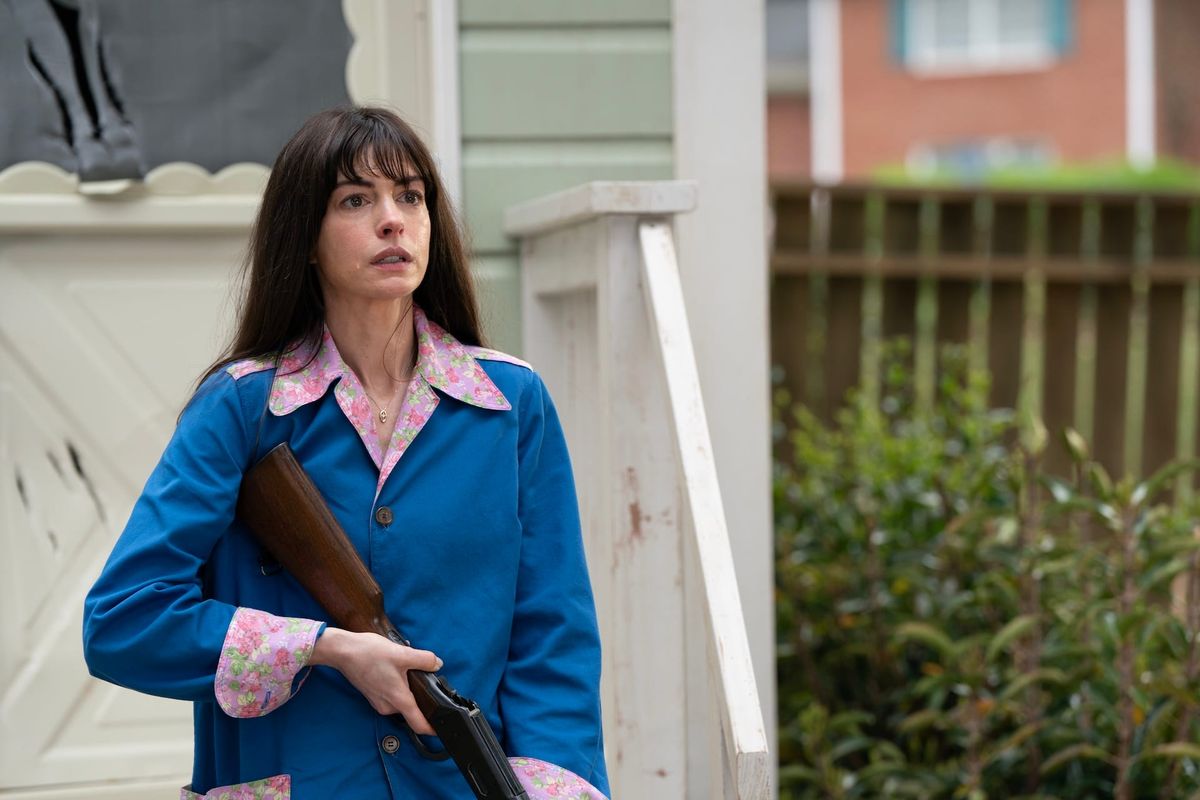
The Platt family lives in a cozy American suburb, but all is not well at home. Parents Denise (Anne Hathaway) and Greg (Ewan McGregor) are bickering constantly; she fantasizes about leaving the family behind to start life anew, and he feels inadequate because he’s had trouble making enough money to support their teenage daughter Audrey (Maisy Stella) and adolescent son Brian (Christian Convery). But nothing brings a family together like being sent back to when dinosaurs ruled the Earth. The Platts and their neighborhood are deposited via wormhole to a prehistoric time, and now the Platts must find a way to survive while dinosaurs proceed to gobble up their fellow suburbanites.
Watching dinosaurs chomp people hasn’t been this fun since the first Jurassic Park. The mundane suburban setting contrasts well against these ferocious beasts. While dinosaurs occasionally made it to mainland settings in the Jurassic sequels, The End of Oak Street returns both the sense of danger and the importance of family that have been largely absent in the follow-ups to Spielberg’s classic 1993 blockbuster. Maybe it’s because the neighborhoods are recognizably my hometown of Atlanta (even though they never announce the specific location in the movie), but the adventure felt grounded and tactile in a way I’ve frequently missed. A film like The Odyssey offers immediacy with its practical locations, but The End of Oak Street has that distinct familiarity that Amblin and other 1980s movies offered—the idea that adventure could be right in your backyard.
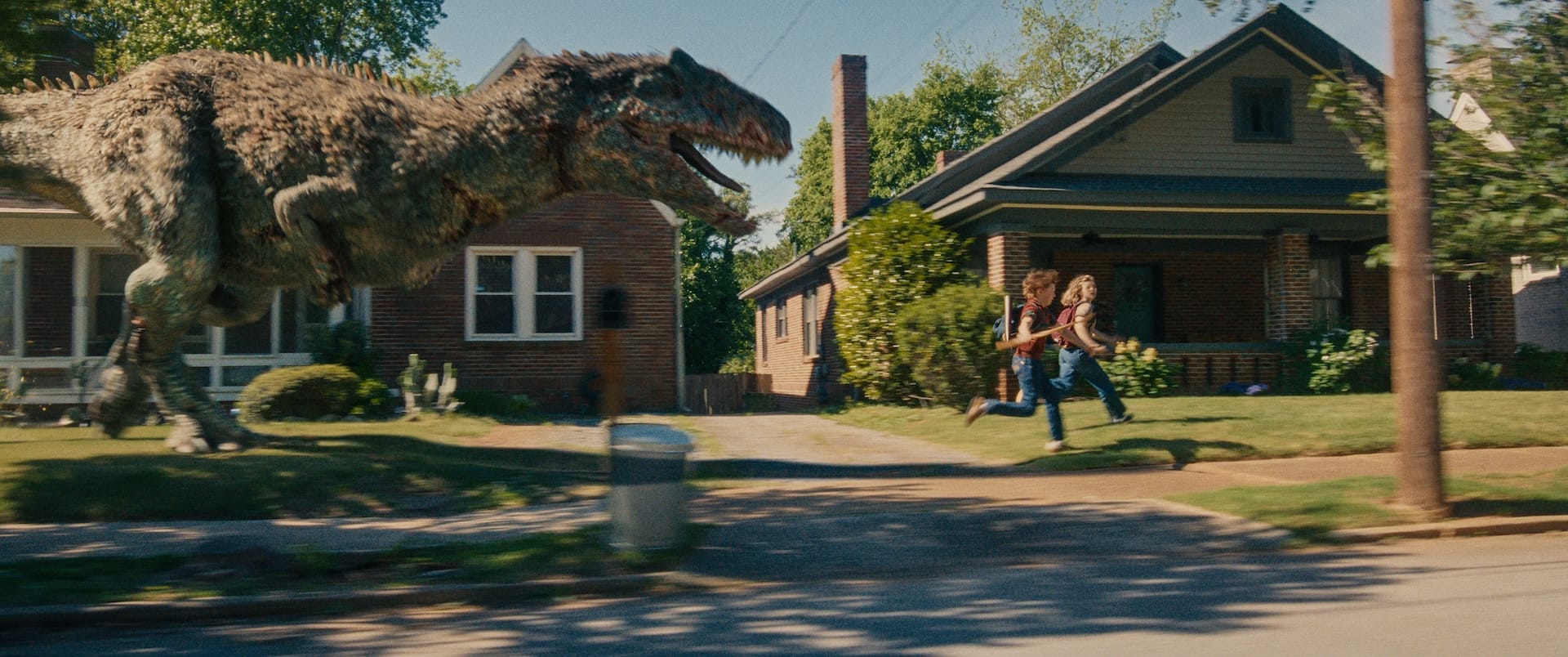
Mitchell also isn’t afraid to show that the dinosaurs mean business, and even the Platts may not be 100% safe. It’s a tricky balance to show the danger these creatures pose without getting too grim, but The End of Oak Street manages to show dinosaurs picking off neighbors without veering into the macabre. Maybe it’s because the dinosaurs aren’t malevolent (hey, they gotta eat), and there’s no villain here, but making this a survival story helps maintain the tension without assigning blame. We’re rooting for the characters to make it through, and the way they’ll have to do that is by banding together rather than defeating some external force.
The thematic underpinnings are where The End of Oak Street gets a little shaky. To reaffirm their marriage, Denise and Greg both have to grow and change, and the constant running from dinosaurs rarely allows for that. Denise is a badass with a shotgun, and Greg has a good heart, but it’s tough to see how either quality heals their marriage. Beyond a basic sense of “you don’t know what you’ve got until it’s gone,” there’s not much specificity in how the characters develop so that, assuming they come out of this mess on the other side, they’ll be stronger as a family. If anything, it feels like Denise has to keep shouldering more of a burden while we wait for Greg to step up, and the conclusion clumsily papers over the lack of a fulfilling completion to their arc.
Maybe in the 2010s, this would bother me more. It certainly did with Super 8, an overt attempt by J.J. Abrams (who serves as a producer on Oak Street) to echo Spielberg’s Amblin movies. That movie annoyed me because the alien serving as a metaphor for the main character’s grief wasn’t a cuddly E.T. but a creature that rampaged through the small town and killed some folks, so (spoiler alert), the boy sending the alien off in his spaceship at the end doesn’t have the same kind of catharsis. The End of Oak Street isn’t as clumsy as Abrams’ movie, but it does lack the emotional resonance of the films it seeks to evoke. And yet, I don’t care as much anymore. I still had fun with it; I liked the performances and the characters, and I was grateful to see a family adventure in recognizable confines. If I’m going to see dinosaurs rampaging around, I’d much rather see them in this kind of story than the eighth franchise film where they’re mostly on a tropical island.
It’s bizarre to think that this kind of broad, family-based blockbuster is now an endangered species, but it is. Hollywood makes fewer kinds of movies than it used to. They make fewer movies at different price points. Rarity doesn’t automatically improve a movie, but I also can’t easily dismiss The End of Oak Street as another blockbuster or another Amblin imitation when the Hollywood landscape looks, to be blunt, woeful. Blockbuster characters often have to be extraordinary or become extraordinary to merit our attention. Some kind of IP or noted real-life individual has to be branded on the front as a weird “seal of approval” that someone, somewhere enjoyed a previous iteration of this thing. The End of Oak Street isn’t much more than a lovable family running for their lives from dinosaurs, but in 2026, that feels like more than enough.
The End of Oak Street opens in theaters on August 14. Matt Goldberg is a film and TV critic who runs the newsletter Commentary Track.