'Wild Horse Nine' Is Martin McDonagh's Most Overtly Political Film to Date. It's Also His Bleakest, and Best.
Stephen David Miller reviews Martin McDonagh's latest. Plus: David shares a few thoughts on 'Godzilla Minus One.'


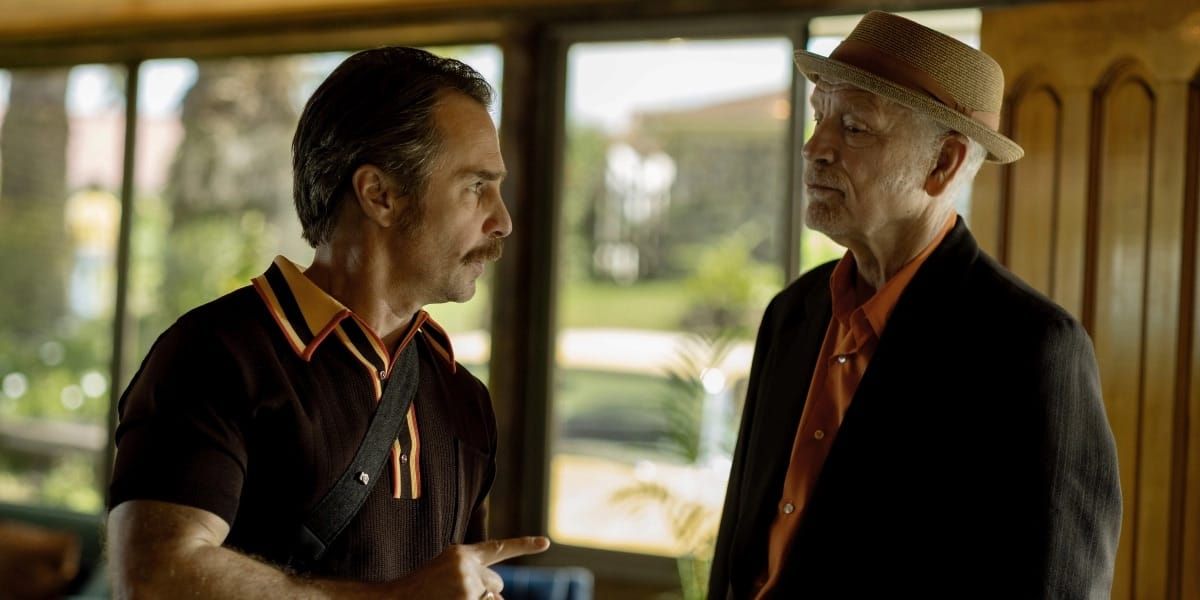
Stephen first covered 'Wild Horse Nine' back in September at the Toronto International Film Festival. To mark the film's wide release, we're publishing an edited and expanded version of his original capsule review.
Chris (John Malkovich) isn’t very good at pep talks. Like many of the characters who populate Martin McDonagh’s filmography, the aging CIA operative long ago lost any glimmer of hope. He’s seen too much to believe in a better future; hell, he’s devoted his career to ensuring things continue getting worse. It’s 1973, and Chris and his colleague Lee (Sam Rockwell) are stationed in Chile on an undisclosed assignment. In a few short weeks, a violent coup will erupt in Santiago, ousting the democratically elected socialist president, disappearing thousands of perceived dissidents, and ushering in the 17-year dictatorship of Augusto Pinochet. But who wants to talk about work on vacation? Here on Easter Island, spirits are high and the skies are still blue. When Chris offers advice to a young activist he meets on the trip, the rosiest vision of the future he can muster is a dignified defeat. You can resist, but they’ll crush you. You can hide, but they’ll find you. You can flee, but they’ll follow you wherever you go. So why not just sit down somewhere pleasant near a body of water, hold a gun, and wait for the inevitable? You’ll lose the fight immediately, as is the tendency of all noble causes. “But at least you’ll die with the wind in your hair.”
It’s a glib sentiment on paper, but it’s rendered poignant in context. This sort of tonal contradiction is at the heart of McDonagh’s artistic sensibilities, and Wild Horse Nine may be its purest expression. The film is steeped in a nihilism so bitter it alters your palate, teasing notes of sweetness out of even the most horrible things. Acrobatically constructed conversations veer into sharp, irreverent detours, tiptoeing just up to the edge of a profound philosophic statement before poking you in the eye with base vulgarity. Morally reprehensible characters, against the backdrop of real historical evils, are used as the vehicle for a tender exploration of male friendship. The Banshees of Inisherin, but with actual ghouls. Even the pacing is a feint, designed to discombobulate you. The story unfolds with a nonchalance that matches the affect of its protagonists, exuding a shaggy “hangout” demeanor which makes the plot feel inessential so you don’t notice that it’s coiling underfoot. There are twists and turns to be had here, and I won’t spoil where they’re headed.
This is the tightest, most satisfying story McDonagh has directed to date. Every seemingly incidental detail eventually serves a purpose. Like the best stand-up specials, it’s hilarious in a shape-shifting way: frivolous, bracing, and cathartic. And in McDonagh’s long history of eliciting memorable performances, I’m not convinced you’ll find any better than these two leads. Rockwell oozes a bravado that barely masks his gooey center; Malkovich hypnotizes you with his lilting syncopation and Pagliacci smile. Both agents reveal themselves in surprising ways over the course of this saga, while keeping a little something extra held back, simmering just out of view. The supporting turns are also excellent and multi-layered, particularly Mariana di Girolamo as the aforementioned activist, Parker Posey as Lee’s semi-estranged wife, and Tom Waits in a brief but gut-wrenching cameo.
Those aspects alone would already make this a top-tier McDonagh film, a virtuosic riff on the bawdy character studies he excels at. But it’s the context that elevates it above the pack. There are broader stakes that haunt this particular narrative, a real world allowed to intrude upon the fiction. It adds a heft that I’ve missed from his previous outings, sharpening all of this craft in service to a point.
In one offhand conversation, Chris pitches an idea for a movie he describes as a “downbeat Western.” Asides like this are clearly meant as catnip for reviewers, but that’s exactly how Wild Horse Nine functions. It’s a downbeat Western, and the way it draws from that legacy makes it McDonagh’s most trenchantly political film by miles. The cowboy archetype was built on the myth of the infinite frontier, of ever more land to conquer and the heroism of those who tame it. Even before the Golden Age of Hollywood, we knew this was a fantasy that papered over other, far uglier truths. But by the time we meet Lee and Chris, there isn’t even the fig leaf of an ideal. No folk tunes will be sung about their exploits. They’re hired appendages of a vestigial cowboy empire which lurches forward not because it’s “noble” but because it can. Weary vigilantes sauntering into unsuspecting towns or nations, changing things by force then moving on down the road. Their discordant tones and protective layers of irony become a study of the American moral character. Chris’s fatalism redounds on us, and his attempts to reconcile the past echo our own ethical grappling. What are we to do when society is past the point of meaning? When we’re aware of our complicity but unable to rein it in?
No one would mistake this for an inspirational film. As with One Battle After Another, though, I find encouragement in its portrait of political exhaustion. A reminder that this sense of hopelessness, like the conditions that provoke it, is part of a well-worn tradition. It’s an appropriately cold comfort, at a time when most other varieties feel trite. I still don’t have an answer for those intractable questions. But when I crack the window to vent my frustration, at least I can feel a breeze.
Stephen David Miller is a film enthusiast and cohost of The Spoiler Warning Podcast, who writes on Letterboxd and his personal blog.
'Godzilla Minus Zero' Is Riveting and Spectacular
Takashi Yamazaki's Godzilla Minus One caught me completely by surprise upon its release in 2023. The film told the riveting story of Kōichi Shikishima (Ryunosuke Kamiki), a kamikaze pilot who had to face his demons in order to gather up the nerve to take on Godzilla, the legendary creature terrorizing post-WWII Japan. I had previously seen Legendary's US-made Godzilla films and found them to be pretty underwhelming, with the most recent ones especially being low stakes trifles filled with unconvincing visual effects. I'd also seen Shin Godzilla, which dazzled me with its ultra-grounded take on how a government bureaucracy might respond to a mass-casualty attack like one perpetrated by Godzilla.
But Godzilla Minus One bested them all. It was expertly constructed, with some genuinely inventive action sequences and an emotional core that grounded the whole enterprise. Audiences caught on, and the film's word-of-mouth was so strong that it ended up grossing over $116 million, eventually also taking home the Academy Award for Best Visual Effects.
Three years later, Yamazaki is back with an equally ambitious sequel, Godzilla Minus Zero. It's 1949, two years after the events of Minus One, and the pilot Shikishima has married Noriko (Minami Hamabe). The two live with their adopted daughter Akiko (Sae Nagatani) and are doing the hard work of moving on from the trauma unleashed in Minus One. But when a new threat to their way of life reveals itself, Shikishima and Noriko find their resolve and courage tested yet again.
The pleasure of watching the Godzilla Minus movies lies in their heist-like construction. These movies are about watching smart people put together an elaborate plan to save humanity, then watching that plan go haywire in various ways as our protagonists do everything in their power to salvage it. Even though they take place over 70 years in the past, the elaborate scientific contraptions pitched by the Disaster Response Bureau's Kenji Noda (Hidetaka Nagasawa) to defeat Godzilla are nonetheless believable and dazzling. It's science fiction that feels like it's a celebration of the concept of science itself. And the premise of both of these films hinges on the idea that humanity can triumph, even in the face of insuperable, inconceivable odds.
But even though Minus Zero spends most of its time focused on spectacular set pieces with world-altering stakes, the film never loses sight of the family that's at the core of its story. The first film, Minus One, was really about what it's like to find and build a family out of ashes. Minus Zero is about what obligations you have to that family, especially when the fate of your country hangs in the balance.
The visual effects are just as spectacular as the first time around (Minus Zero is the first Japanese production ever filmed for IMAX), and the sound design might be an even bigger star this time. Minus Zero runs just a bit over two hours but the pacing is nonstop from beginning to end. I could barely catch my breath while watching this thing and honestly, I didn't really want to. -David Chen