How Christopher Nolan Modernized ‘The Odyssey’
Christopher Nolan’s adaptation speaks to us with more than just modern dialogue.

[Spoilers ahead for Christopher Nolan’s adaptation of Homer’s The Odyssey. This is the first of two pieces exploring the themes and ideas of The Odyssey here on Decoding Everything. Subscribe to make sure you don’t miss our summer coverage.]
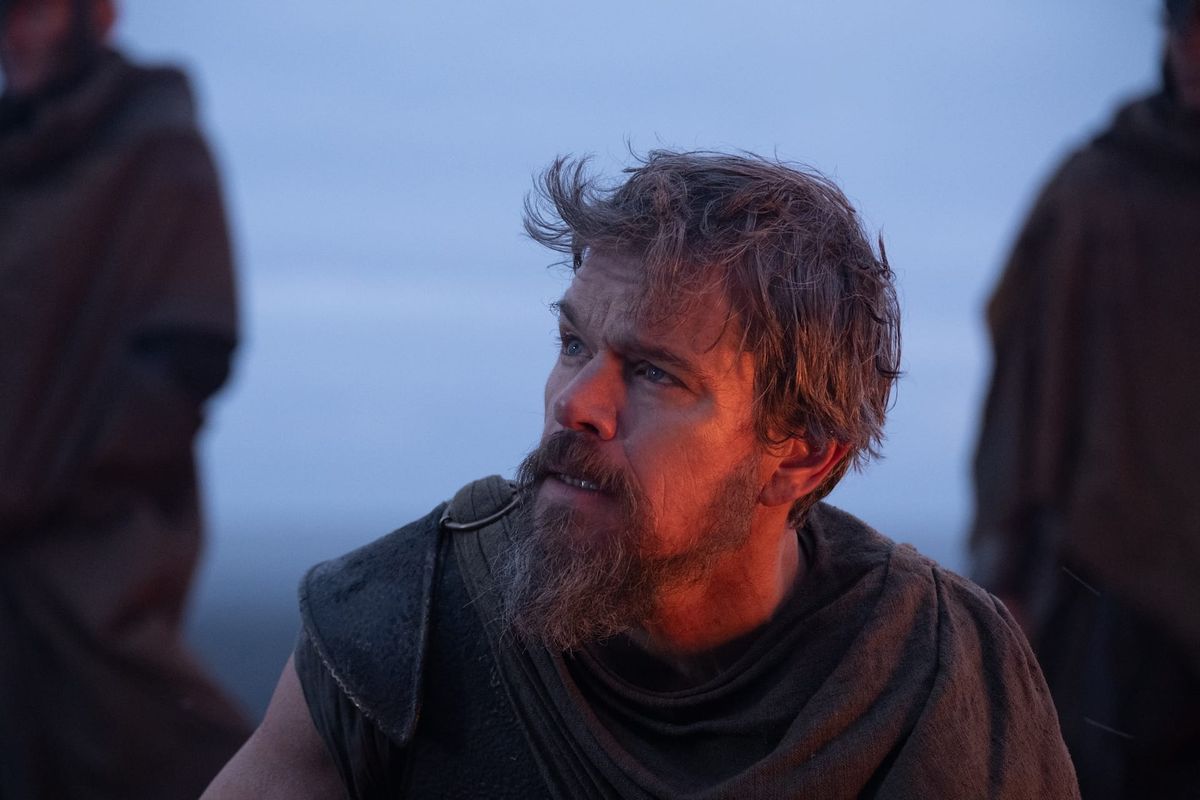
If you’re looking for Christopher Nolan’s new version of The Odyssey to only replicate the ancient, mystical trappings of Homer’s epic poem, you will likely miss how effective he is in speaking to his modern audience. Just as new translators would readjust The Odyssey to speak to their culture and mores, Nolan is not the first to alter the translation or even to change events.
While there is plenty in Homer’s world that remains foreign, from giant monsters to magic powers, let’s delve into how Nolan repurposes ideas such as hospitality, the agency of women, and the relationship between gods and men, to create a fresh dialogue with the epic poem and rethink it for our present age.
Xenia
The most important element Nolan carries over from the text is the concept of “xenia,” or “Zeus’ Law” as it’s referred to in the movie. In fact, one of Zeus’ titles, as Bernard Knox points out in his introduction to Robert Fagles’ translation of The Odyssey, is “xeinios,” meaning “protection of strangers.” Knox explains, “In such a world, a man who leaves his home depends on the kindness of strangers. Without a universally recognized code of hospitality, no man would dare travel abroad; its observance is therefore a matter of self-interest.”
And yet even within the text of Homer’s play, those rules don’t always hold fast. The Phaeacians provide every hospitality and kindness to Odysseus, but because he blinded Poseidon’s son Polyphemus, Poseidon punishes the Phaeacians and creates an earthquake that shuts them off from the world. While scholars of classic literature can further unravel the purpose of these narrative choices, Nolan creates a consistent framework for a modern audience that only needs to understand that there was a rule of xenia that all had to obey.
The reframing is that while people in this world know Zeus’ Law, they no longer recognize or appreciate it. An early mention of the law by the suitors is scoffed at as they abuse and berate a beggar, not fearing he could carry a god’s wrath. At the film’s climax, we learn Odysseus broke that law by betraying the Trojans, using a gift as a weapon. He was a hero of the Trojan War but lost the world (similar to the protagonist of Nolan’s previous movie, J. Robert Oppenheimer, who wins World War II with the atomic bomb, but unleashes a far more dangerous climate of mutually assured destruction). Through the constant conflicts the crew encounters with the Cyclops, Circe, and others, we see that if Zeus’ Law held, then there would be safe travels home.
We see this kind of dangerous xenophobia in our world. Rather than embracing xenia–the protection of strangers on merely practical grounds that protecting the traveler protects us all–demagogues seek to make xenophobia into nationalized policy under the banner of “defending the border.” We can even see this in our media, which is predicated on playing into conflict rather than hospitality. We carry around little devices that let us go anywhere we wish to discover only to have someone on the other side demand a fight over anything. This isn’t because of the substance of the conflict any more than a cyclops has long-standing beef with the people of Ithaca. It’s that we, like Odysseus, have made a world where tribalism cuts us off so completely that nowhere will have us.
Odysseus and his crew receive no hospitality from hosts such as Polyphemus or Circe, but the lack of hospitality cuts both ways, as we see from the behavior of the suitors. While Telemachus and Penelope are obligated to play host to these guests, the suitors are abusing a system for maximum exploitation. They’re not the weary beggar as we see in the beginning of the film or later Odysseus in disguise. They don’t care if the beggar is a god or not because they already feel like gods. They will do what they please without friction and punish anyone who gets in their way. Although this is true to Homer’s text, the harsh treatment towards Odysseus and his crew in the movie creates a noteworthy parallel. In a world where xenia has broken down, it’s impossible to tell the difference between intruder and guest. No matter which side of the table we’re on, we’re playing defense.
The Depiction of Women
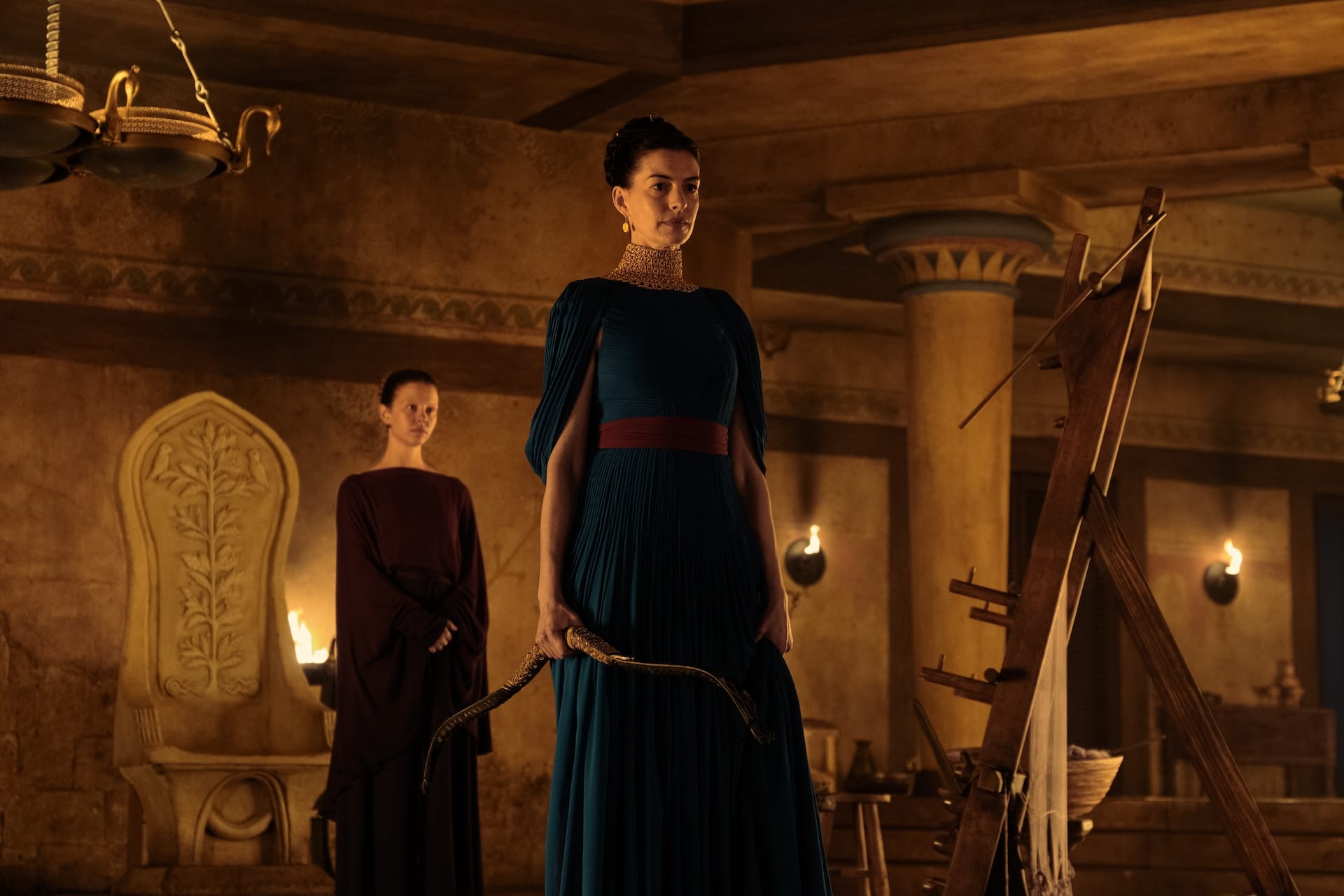
Perhaps it was asking a bit much of Homer to have the most enlightened view of women, although Penelope is a character for the ages, and her cleverness and fortitude help her stand apart from almost any other woman in the text. But Nolan goes far beyond singling out Penelope as “the good one,” and instead changes the women of The Odyssey into rich characters who have interests, shading, and can’t be easily dismissed as mere supporting figures in Odysseus’ journey.
We see this early on when we meet Helen, and her husband Menelaus jokes that she was the face “that launched 1,000 ships; well, maybe 500 now,” before showing he has disfigured half her face. He revels in his cruelty, showing Helen to be his mere possession, and even the larger film acknowledges that the return of Helen is a flimsy pretext for Agamemnon to take control of the shipping lanes. Rather than the romantic focal point of the battle, Helen is treated as little more than a pawn and shown as an object of Menelaus’ abuse.
Both Menelaus and Agamemnon share a warning about unfaithful wives, with the latter killed by Helen’s twin sister Clytemnestra. In Homer’s text, Clytemnestra conspiring with her lover to kill Agamemnon is meant to raise the stakes for Odysseus; to place in his mind that such a fate could be waiting for him after his long homecoming. Helen and Clytemnestra are defaulted as betrayers, with Helen only being “good” for recognizing her transgression. “Launching your headlong battles for my sake,” she says, “shameless whore that I was.” (4.159-160, Fagles).
By shifting the blame to Menelaus and Agamemnon rather than the behavior of their wives, Nolan foreshadows the culpability of Odysseus, not in how he treated Penelope, but in the breakdown of hospitality. Telemachus and Mentor are allowed to sit at Menelaus’ table and at his feast, but this is a far cry from the rich hospitality Telemachus receives in the text. Instead, there’s a sense of violence in the air, and Menelaus’ willingness to disfigure his own wife, a woman as beautiful as Helen (and this is where casting an actor as stunning as Nyong’o is essential), indicates that no traveler is truly safe under the king’s roof. Agamemnon’s willingness to sacrifice his own daughter for victory on the battlefield is another transgression of the home, and one that gives Clytemnestra not only agency, but just cause for taking revenge against her husband.
Perhaps the best rendering of recasting women in Nolan’s Odyssey is Circe. Far from the seductive enchantress she’s usually portrayed as, the film wisely recasts her as vulnerable and earthy, a woman living alone. Odysseus’ crew, consumed by their own desires and hunger, storm in not as guests, but making a demand: “Feed us.” Although the crew does not initiate sexual violence, Nolan understands that such a threat is always implied, especially when Circe is so vastly outnumbered. The men transforming into pigs is not merely about the violation of Zeus’ Law where hospitality is demanded rather than requested, but an expression of carnal desires that turns traditional representations on their head. It is not Circe who lures the men, but the men having their desires turned against them. It is only by matching wits with Circe—treating her as an equal—that she agrees to help Odysseus find his way home.
“Athena”
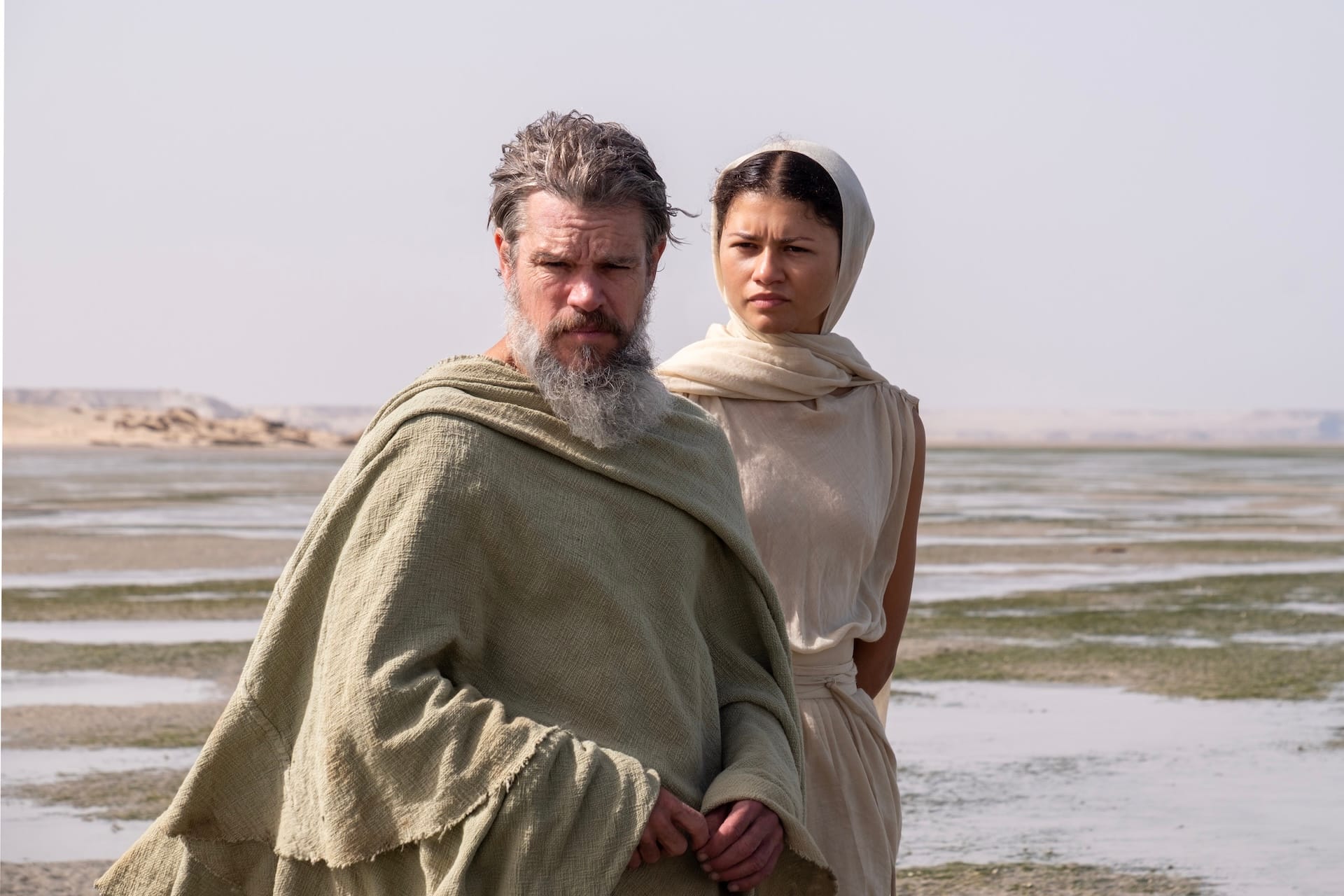
“The gods do not speak to us in ways we understand,” Odysseus notes early on to a vision of Athena. The gods are far more prevalent in Homer’s text (although not as much as in The Iliad, where they play central roles), especially Athena, who aids not only Odysseus but Telemachus as well. The Athena of the poem is of far greater help, able to hide and assist father and son, showing them her favor. The Athena of the movie, on the other hand, exists more as a haunting reminder, but of what, we don’t understand until Odysseus confides in Penelope the truth about what happened at Troy.
Up until the climax, we would reasonably believe that the Athena we see is Athena; this is The Odyssey after all, and perhaps Zeus is present in the thunder, Hades in the land of the dead, and Poseidon in the churning seas. But rather than the gods who typically interacted with mortals, Nolan instead treats us to a modern, atheistic rendering of higher power, where there are no gods; only men.
This becomes clear when we learn that the Athena we’ve seen the whole movie looks the same as a young Trojan woman who was slaughtered right in front of Odysseus and before he cut the head off a statue of the goddess. It’s a loaded scene, conflating mortal and god, and hammering home the idea that we treat the stranger with kindness not because they could be a god, but because our humanity means little when we treat others as sub-human. Nolan cleverly inverts the text, showing not a god masquerading as a human, but a human elevated to the level of a god so that Odysseus may wrestle with his own conscience.
You could argue that the Athena we see in the film is the literal Athena, but to do so would ignore all the purposeful departures Nolan takes to depower the divine. She doesn’t provide him with assistance, she doesn’t give him special knowledge, and there is no other personification of gods. She is, to put it bluntly, Odysseus’ trauma made manifest, a representation of breaking Zeus’ law and therefore breaking the world. Similar to Oppenheimer imagining the cheering crowd at Los Alamos ravaged by the atom bomb, Odysseus now lives alongside the reminder of the carnage he created.
When he says that the gods don’t speak in ways we understand, Odysseus is being willfully obtuse, refusing to acknowledge the clear message of his guilt. His journey of trying to save his men is what he thinks will redeem the journey; if he can bring them home, then order will be restored, and the world can go back to the way it was. But as the film’s ending makes clear, with Odysseus and Penelope sailing off to parts unknown, you can’t go home again.
Denying us an easy homecoming is perhaps the most modern of Nolan’s touches, leaning into the uncertainty and ambiguity of our current age. Homer closes his poem not with the destruction of the suitors, but by healing the family with Odysseus made known to both Penelope and his father, Laertes. The man of “twists and turns” still plays his games, using ruses to uncover the truth, but his story has come to a firm conclusion by setting the world right. Nolan implies that the world, even if healed, will only fall into despair with a story misremembered. You’ll marvel at the giant horse and disregard the destruction it caused.
Matt Goldberg is a film and TV critic who runs the newsletter Commentary Track.