Christopher Nolan's 'The Odyssey' Is About How You Really, Really Can't Go Home Again
Christopher Nolan's The Odyssey is a spectacular, epic, unforgettable adventure film that makes an ancient text relevant for the modern era.

[This movie review will assume you know basic plot details about Homer's The Odyssey and will discuss the overall structure of Christopher Nolan's film. Also, sadly, I haven't yet seen the film in IMAX yet so I can't comment on that component of the experience.]
Christopher Nolan's The Odyssey is a spectacular, epic, unforgettable adventure film that makes an ancient text relevant for the modern era. While its set pieces will attract well-deserved attention for their ambition, scope, and execution, what really stuck with me was how Nolan was able to create a compelling emotional through line out of this classic tale.
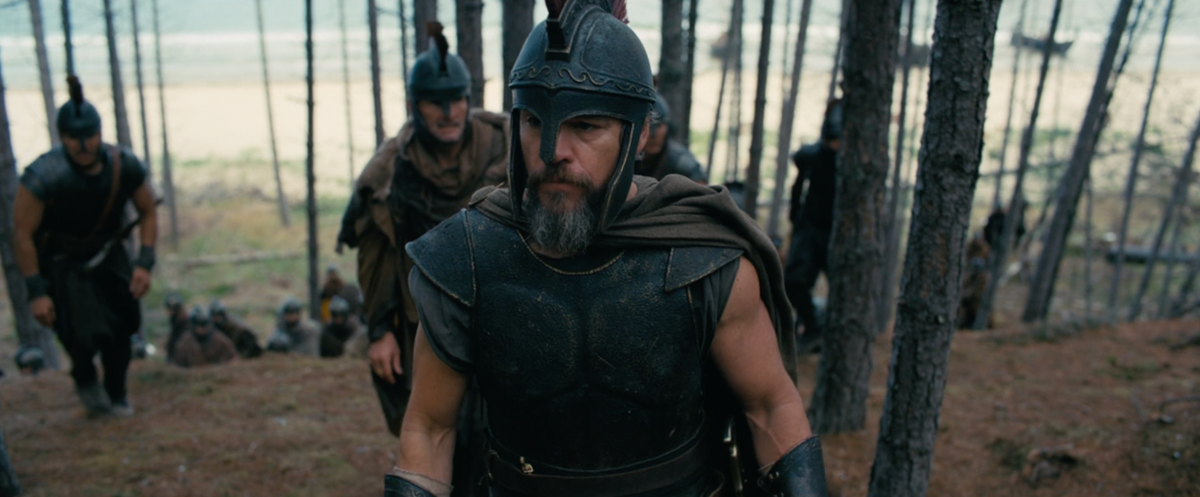
Nolan's The Odyssey is still about what keeps Odysseus (Matt Damon) from making it home, but it's also about his wife Penelope's (Anne Hathaway) anguish at his prolonged absence, and the impossible position she finds herself back in Ithaca – not to mention their son Telemachus' (Tom Holland) desire to prove himself as a worthy heir. Nolan's films have often been about messy and strained familial connections (see: Interstellar, The Prestige, Inception) and he's able to apply that fractured lens here to great effect. The result is a film that not only pushes the envelope for what's technically possible on screen, but also lands an emotional wallop that will leave you ruminating on the story's themes and modern day parallels.
To do all this, Nolan marshals a few of his typical storytelling tools. The first is his penchant for non-linear storytelling. As in Homer's epic, Nolan chooses to start The Odyssey about a decade after the fall of Troy. Penelope and Telemachus have been waiting for Odysseus' return for about twenty years. Doubting that Odysseus is even alive, dozens of suitors invade her house on a nightly basis and abuse society's adherence to Zeus's law, which states that every stranger must be treated kindly as they may actually be a god. Tensions over their presence continue to escalate and threaten to spill out in unpredictable ways. Meanwhile, Odysseus is marooned on an island with a mysterious companion (Charlize Theron), trying to remember his past life and what his original destination even was. Nolan then tells most of the rest of the story in flashback. We learn about how the Trojan War played out and the many trials and tribulations that Odysseus and his men faced on the way home. But by starting the story where he does (and by spending almost the entire first hour setting it up), Nolan keeps the story grounded in an extremely relatable situation that drives the entire film: A man's family is in trouble and he needs to get home to them ASAP.
This structure also allows the final act of the film to hit in unexpected and intense ways. I don't want to reveal too much about the ending but I can say that I've always thought about Homer's The Odyssey as being a text about how logistically and physically difficult it was for one man to make it all the way home. What Nolan's The Odyssey suggests is that perhaps it was difficult in emotional and spiritual ways as well. It's not the most profound idea but it's one that ends up having a lot of resonance in the political moment we find ourselves in today.
The cast of the film is phenomenal and, because it's a Nolan film, pretty much everyone in Hollywood is willing to appear. A-list actors show up to deliver a few lines, then vanish from the rest of the film. Uniformly, the work is excellent, but the star wattage of everyone's presence manages to imbue the film with an almost otherworldly quality. After all, other than politicians, celebrities are the closest thing we have to gods and kings. Beyond the core trio of Damon-Hathaway-Holland, who do much of the heavy lifting, special attention must be paid to Robert Pattinson, who plays the suitor Antinous with such a sniveling, loathsome energy that he's likely to become one of the most hated film characters of the year. Himesh Patel is also a highlight as Eurylochus, Odysseus' right hand man and a quasi-audience surrogate.
But let's talk about what will attract a lot of people to this film: the set pieces. Many of the well-known classics are here. The Trojan Horse. The fall of Troy. The Cyclops. Hell, even the Laestrygonians!
[Side note: One downside of cramming all these encounters into a three-hour runtime is that the film often feels episodic in a bad way. As the viewer, we're barely given the opportunity to even comprehend what we've seen, let alone process it, before it's on to the next set piece. I know if I just saw a cyclops eat my friends, I'd probably be talking about it constantly for a few years and not just several seconds like in the movie.]
What's special about the way these scenes are rendered here is Nolan's signature style. Nolan famously tries to minimize his usage of CG, choosing to shoot as much material in camera as possible. When he does use visual effects, it's typically to enhance something that's been filmed in the real world, as opposed to creating something digitally from scratch (not that there's anything wrong with either approach!). Combined with the use of all natural lighting, the result here is a fantastical world with incomprehensible wonders that somehow "feels" real. This feeling is evident when you see hundreds of people pulling enormous ropes to haul the Trojan Horse off the beach; when you see an enormous cyclops move a rock the size of a building; and when you see Odysseus' men try again and again to make landfall on a seemingly endless supply of spectacular looking beaches.
The Odyssey begins with the text on screen that reads "A time of apparent magic", signaling that what we're about to see may make us question what's real and what's not. The words also bring to mind The Prestige, another Nolan film that dealt with the world of magic. At a climactic moment in that film, Robert Angier, one of the film's two dueling magicians, delivers a monologue to his arch nemesis:
The audience knows the truth: The world is simple, miserable, solid all the way through. But if you can fool them, even for a second, then you can make them wonder. And you get to see something very special. You really don't know? It was the look on their faces.
With The Odyssey, Christopher Nolan has once again increased our capacity for wonder. And he's made a film that is not only one of the best of the year, but also a thought-provoking interpretation of Homer's timeless story.
The Odyssey is out in theaters this weekend.
Other Stuff David Chen Has Made
- On Decoding TV, I recently chatted with Patrick Klepek about why people don't seem to make it to season 2 of Netflix shows.
- Also on Decoding TV, Patrick Klepek and I have been rewatching Dark Matter season 1 in the lead-up to the second season premiere in late August.
- House of the Dragon season 3 is off to an incredible start and I was happy to join Jessie Earl and Kim Renfro to discuss it on A Cast of Kings recently.
- On The Filmcast, we reviewed The Furious, which is one of the best martial arts films of all time.