'Paper Tiger' is a Tense, Haunted Portrait of the American Dream
James Gray's latest is a cautionary tale with the texture of a memory and the pulse of a thriller

Stephen first caught 'Paper Tiger' at the Cannes Film Festival, and briefly covered it for Decoding Everything. Now that it's rolling out in theaters, he's returning with an edited and expanded review.
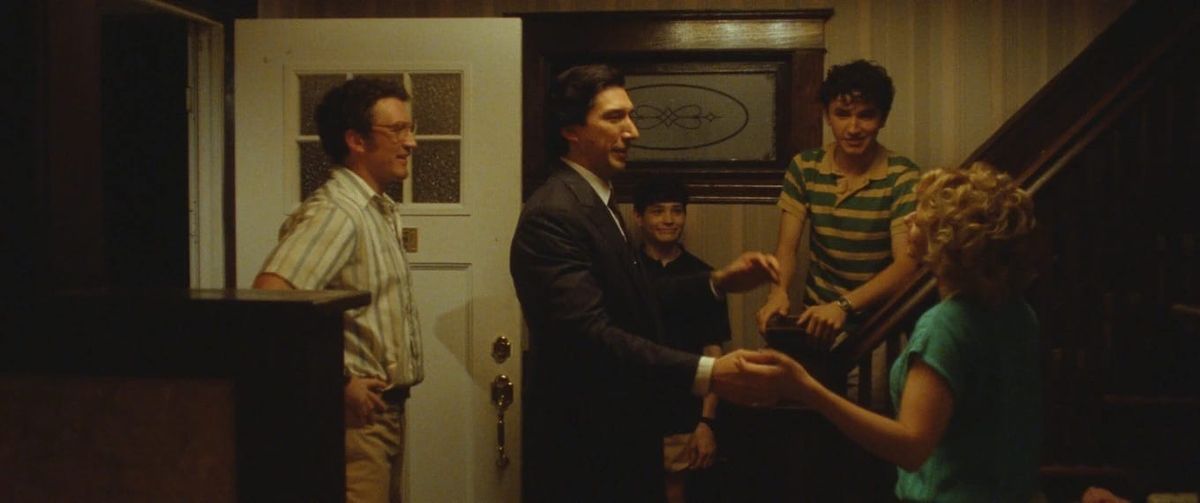
Six years into the Reagan presidency, the Pearl family is overdue for a win. The patriarch, Irwin (Miles Teller), believes in the value of hard work. His environmental engineering business isn’t exactly printing money, but it’s enough to support a family of four with a modest two-bedroom home in Queens. Hester (Scarlett Johansson) wishes her husband would consider moving out to Great Neck, the Long Island enclave with a thriving Jewish community where her mother lives in something approximating luxury. It’s quiet there, and so much safer for the kids! But to Irwin, leaving the boroughs would feel like a defeat. There’s a siren song to New York City, a sense of untapped opportunity hiding just around the bend. The promise of real, enduring success for those who know where to look. Irwin’s brother Gary (Adam Driver) has a knack for finding it. The former NYPD officer turned security consultant is living the dream: well-tailored suits, a shiny Mercedes, Peter Luger steaks he can get delivered on a whim. So when Gary shows up one night and offers to let his brother in on a new construction project, it doesn’t take much for Irwin to be persuaded. He heads down to the Gowanus Canal to survey the site, meets the Russian developer at the helm of the operation, and agrees to draw up a preliminary report for a staggering $10,000. For a while, it seems too good to be true. Then the mob gets involved.
Longtime fans of James Gray will recognize aspects of this story. The director first came on the scene in 1994 with Little Odessa, a drama about the Brighton Beach mafia and a fractured family caught in its snare. Since then, his subjects have varied, but certain themes recur. Brothers who mirror or push one another. Young people exposed to violence. Ailing or absent mothers. Fathers whose drive to mold their children winds up alienating or hurting them. The gritty realism of his earlier work took on more operatic layers, until by Ad Astra the emotional rift between father and son could span a literal solar system. Then with Armageddon Time he pulled us back to earth, telling a grounded coming-of-age story. It was unmistakably autobiographical, following a boy growing up at the same time as Gray, with a family that resembles his own, set in his childhood neighborhood in Queens. Genre trappings were stripped away, and what remained read like a confessional diary entry. Some critics were moved by the soul-baring attempt; others saw it as a misguided, self-centered endeavor.
Paper Tiger was originally conceived as a sequel to Armageddon Time, and its DNA is evident in the script: “Esther” and “Irving” are now “Hester” and “Irwin,” with the setting left virtually unchanged. But as a work of art, it wholly stands alone. In fact, I’d argue it surpasses the prior film in every respect, serving as a Rosetta Stone for Gray’s artistic output without a whiff of self-indulgence. Here his two modes of storytelling are blended together, a personal family portrait filtered through a genre lens. When asked by Rolling Stone about the film’s authenticity, Gray described it as 90% factual as opposed to its predecessor's 98%. What formula he used to derive that, and how much it weighs emotional versus literal truth, are unclear. But that blurry 10% makes it richer and more revealing. As The Fabelmans did with Spielberg, it lets us draw a line between Gray’s life and his creative preoccupations, retroactively tinting his more obviously fictional work.
Much of the film’s magic lies in what it obscures. Beautifully captured on 35mm, it reads on screen as a half-forgotten memory. A crucial, troubling artifact bottled in the psyche, buried under four decades of accumulated dust. Stylistically that makes it feel closer to The Conversation or Bad Lieutenant than any modern crime drama I can recall, but it runs deeper than the period aesthetic. There’s a texture that permeates the narrative, a palpable unease. Inaudible dialogue, erased by the clatter of the city. Nefarious figures we never see directly; only shadows, looming large on a dimly lit wall. Vague insinuations about the New York political machine, a web of forces no one will speak to on the record. Headaches that bleed out onto the lens of the camera, blinding our periphery. A skyline barely visible through tall stalks of grass. By keeping us in the dark, Paper Tiger avoids the clumsy, fluorescent faux clarity of a memoir. It’s a morality play that can’t quite suss out the shape of its moral, and that grasping quality makes it so much more impactful.
“Let there be wealth without tears; enough for the wise man who will ask no further.” This quote by Aeschylus opens the film and describes a foundational myth the narrative will puncture. Wealth without tears; the ability to amass just enough then pump the brakes before doing damage. It’s an appealing idea, and it’s essentially the promise of the American middle class. But “enough” is not a fixed point, as countless cautionary tales can attest, and there is no positive accumulation in a zero-sum system without some symmetric loss. Whether you absorb the tears yourself or push them further downstream, that byproduct needs to flow somewhere. For all our social niceties, there’s a ruthless logic at the heart of our economic engine. A feral creature tucked out of view.
What follows unfolds like a classic Greek tragedy, cycling through the perspectives of three protagonists and their delusional relationship with that creature. Irwin clings to the idea of a meritocracy, sturdy rules by which all things abide. Wake up early, keep your ear to the ground, and eventually good luck will come your way. Teller plays him as loving and unobtrusive with just a hint of entitlement—we can see how he would be blind to the risks of his new venture, and how his subsequent shame might harden into emotional distance. Meanwhile, Hester wants to quarantine the ugliness around her. There may be bad things happening Out There, but she can hold them at arm’s length and keep her children safe. Johansson is excellent in the role, and heartbreaking in ways I can't spoil. One line of dialogue in particular has stuck with me, a Job-like plea for fairness in a world that doesn’t care. But it’s Adam Driver as Gary who leaves the most striking impression. The streetwise entrepreneur sees the beast’s stripes clearly but believes that he can tame it, dancing through the danger like Siegfried or Roy. He’s the confident embodiment of the American ideal. Dress for the job you want. You’ve got to spend money to make money. Just keep those plates spinning and they’ll eventually propel you out of your social stratum, defying gravity like cryptocurrencies or Tesla stock. Gary works hard to maintain his standing in a world of crooked cops and wheeler-dealers, with a ferocity that looks like strength but is ultimately paper thin.
Paper Tiger mirrors Gary’s demeanor: steady on the surface, turbulent underneath. It plays with subterranean tensions, provoking Uncut Gems levels of anxiety while rarely letting you see it break a sweat. There are few surprise twists, and even fewer consciously showy set pieces. Just a constant, methodical tightening of the screws around a nightmare the director would spend the rest of his career reexamining. As with the last animal-adjacent period piece I raved about on this site, this is fairly bleak material, and this time around, there isn’t much levity to cut it with. Yet it never comes off as dour or oppressive. It’s riveting, a slow-burning drama with the pulse of a thriller. At a time when a deluge of awards contenders are rushing to theaters, I worry that this one might get lost amid flashier fare. Don’t let it pass you by. It’s one of the most rewarding, self-assured films of the year.
Stephen David Miller is a film enthusiast and cohost of The Spoiler Warning Podcast, who writes on Letterboxd and his personal blog.