‘The Uprising’ Awkwardly Weds Paul Greengrass’ Documentary Style with Tired Medieval Drama
Greengrass’ handheld approach pulls us further away from historical realism.


Given the positive reception to his 2020 Western News of the World, perhaps it’s not surprising that director Paul Greengrass mused about how much further he could push into the past with his documentary style. That style served him well in telling modern true stories like Bloody Sunday, United 93, Captain Phillips, and 22 July, as well as changing the language of action cinema for a solid decade thanks to the success of the second and third Jason Bourne movies. However, by applying it to the Peasants’ Revolt of 1381 with The Uprising, Greengrass only highlights the phoniness of familiar medieval tropes that feel too well-worn to play with any authenticity. Furthermore, the modern parallels are drawn so broadly as to give The Uprising a view from nowhere. Flickers of interesting ideas regarding protest movements never catch fire, and instead we’re left with an ending so laughably pat and simplistic that it snuffs out any originality of the previous two hours.
Our story follows “Ploughman” (Andrew Garfield), a man who says, “I am what I do,” and has lost his wife and children to the recent plague. The advisors to the young King Richard II (Woody Norman) want to raise funds to support ongoing wars but won’t take it from the merchant class because they don’t want to give a seat of power to merchants, and the Church also refuses to part with its wealth. That leaves taxing the peasants. As local lords extort money from peasants and sexually assault their young women under the pretext of “checking their age,” Ploughman flies into a fury and fights back. His rebellion coincides with the fight of priest John Ball (Jamie Bell), former nun Alyce (Thomasin McKenzie), and ex-soldier Wat Tyler (Cosmo Jarvis). As their forces mass on London, agendas conflict, with some seeking revenge against the King’s counselors while those like Ploughman only want redress of grievances and greater freedom.
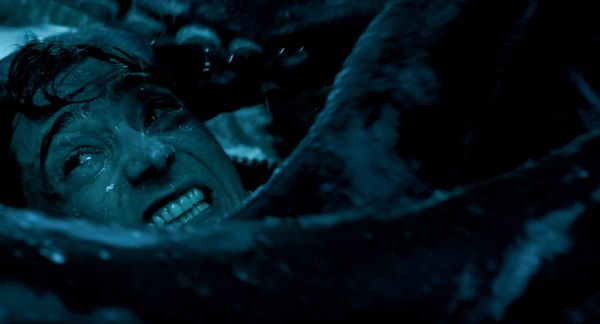
Ploughman is far from a rich character, and it feels like a waste of Garfield’s abilities. He’s a grieving man who inadvertently finds himself leading a rebellion, and the film refuses to give him any shading, instead letting Garfield’s sweet countenance play as the movie’s moral center. There are times when it feels like this sparse rendering is meant to feel akin to the ensemble pieces of United 93 and Bloody Sunday, where quickly sketched characters are meant to carry us along a chain of events, but The Uprising falls far too neatly into heroes and villains. Even John Ball, who’s a bit of a wild card given his anger towards the Church’s hypocrisy, offers more sound and fury than questionable actions. The darkest the film gets from the perspective of the peasants is when the rebellion leads to looting and violence in London and the leaders can’t contain it.

The question of when protest spirals into a riot, as well as the differing agendas of protest leaders, makes for the film’s strongest modern parallels, but the script does little to build anything constructive or thoughtful. Greengrass paints in such broad strokes that a viewer could see the Black Lives Matter protests of 2020 or the Insurrection of January 6th (the latter comparison feels particularly loaded when one of the King’s advisors refers to the peasants as “deplorables,” thus equating this group with Trump’s MAGA base). Given the director’s larger filmography, he tends to lean left (22 July is a film about the rise of far-right violence), but his script coasts on the surface of vague notions of income inequality and “freedom.”
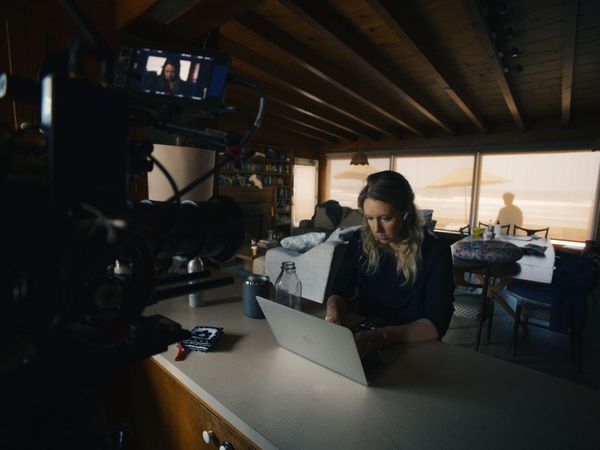
These are distinctly modern concepts, and it’s unclear how much Greengrass wants to make the “reality” of this medieval world come to life. His familiar visual style of handheld, zooms, and other cinema vérité touches would imply that he wants to make this “real.” But medieval peasants likely didn’t have Andrew Garfield’s perfect teeth; they wouldn’t speak in this kind of modern English, and their concerns would not feel so acutely familiar. At some level, we need to accept that 14th-century England is a foreign land, and yet every narrative and visual choice accents what we know as modern viewers. If your characters never rise above the level of archetype, then the immediacy of the camerawork isn’t enough to make them feel real. They become figures at the Ren Faire, and the camerawork only underlines the phoniness that other movies breezily ignore because they lean into grandiose visuals that fit with contemporary ideas of medieval life.
Despite this grating mismatch, I could still kind of hang with The Uprising even if I felt it was constantly working against itself. I kept hoping that perhaps Greengrass would arrive at a specific political idea or conflict rather than the familiar tension of popular unrest, and he did arrive at…something. But that arrival signals the film’s worst and simplest idea. However, it comes in the last ten minutes, so I need to go into spoilers.
[SPOILER AHEAD]

You may have heard that the film was taglined “The Rise of Robin Hood” (although the tagline was worked in so awkwardly that some mistook this for a new subtitle). I wondered if this was just a marketing phrase and that a movie that took place in 1381 had nothing to do with Robin Hood, a figure tied to the reign of King John in the late 1100s/early 1200s. And up until the final ten minutes, there is no sign of Robin Hood.
But when our surviving characters, Ploughman and Alyce, arrive back at Ploughman’s burned town, he weeps, smears mud from the graves of his family on his face, brings a hood over his head, and puts a mask over his face. We then cut to one year later when the King, his mother, and the Mayor of London are riding down a forest road, and they’re accosted by a group of masked bandits. The bandits’ leader fights and kills the Mayor of London, and drags the King out of his carriage. The bandit leader removes his mask to show that he’s the Ploughman, and says that he and his group will live free in the forests and be the stuff of nightmares to the King. The film ends with a shot of the King’s castle and the sounds of his screams.
I had to find an interview with Greengrass to get his thoughts on the Robin Hood of it all because the scene feels like it was added in reshoots to end on an upbeat note. In an interview with The Hollywood Reporter, Greengrass says that the Robin Hood element was always his intent, and the film’s original title was “The Hood.” He felt like while the Robin Hood character harkens back to the 1100s, the story didn’t start taking root until after the Peasants’ Revolt as a way of expressing disdain towards the powerful, and thus the coding of Ploughman as Robin Hood (even though he’s never named as such) is meant to signal that change.
But all of this smacks of a facile, tidy resolution that feels like a far cry from the darker, uneasier emotions of other Greengrass dramas. To give Ploughman a win by killing the Mayor of London but not killing the King, even though the King betrays the peasants and has them slaughtered, and then ending with, “Well, we’re going to live outside of society as bandits, and I will torment you with psychological warfare because you’ll know we’re out in the world,” is some of the clumsiest storytelling possible. If the intent was always to arrive at Robin Hood, then the payoff doesn’t feel remotely rewarding or satisfying. It doesn’t feel like the natural conclusion of Ploughman’s arc as much as a way to abandon any shreds of complexity the story offers. Does Greengrass think that those in modern protest movements resort to lives of crime? Do they become survivalists? With no political theory, the ending feels like it was meant to be a “Surprise! It’s Robin Hood!” but the marketing gave it away, which doesn’t matter because it makes so little sense anyway.
[END SPOILERS]
The most confusing part of The Uprising (aside from the ending) is why this story would appeal to Greengrass beyond the time period. Bloody Sunday is a much stronger rendering of protest colliding with violent power, and attempting to find a modern parallel in the story of the Peasants’ Revolt only showcases the script’s thin characters and broad political subtext. You can’t get the story “right” because so much time has passed for total accuracy, and the dramatic license in The Uprising always ends up flattening the characters rather than adding any worthwhile shading or surprises. Perhaps a stronger script would have served Greengrass’ handheld style, but instead, his roving camera can only capture the most generic version of this old tale.
The Uprising is now playing in theaters. Matt Goldberg is a film and TV critic who runs the newsletter Commentary Track.