
‘Tony’ Excels by Looking at the Man, not the Myth
The story of a young Anthony Bourdain is a rich coming-of-age tale that doesn’t care for standard biopic tropes.


As I mentioned in my review of Michael, a depressingly large percentage of modern biopics concern themselves with familiarity for the sake of propping up the estate of the deceased. You’re not here to find something true; you’re here to reassure viewers who liked the departed celebrity. From what I know of Anthony Bourdain from his searingly honest work like his book Kitchen Confidential, as well as what I’ve seen from his TV series No Reservations and Parts Unknown, he would hate that kind of disingenuous pablum. Thankfully, director Matt Johnson appears to know that as well and instead focuses on how, to become the Anthony Bourdain countless people came to respect, he had to ditch the mythmaking and inflated ego of youth. Tony, by being a coming-of-age story rather than a testament to Bourdain’s legacy, ends up as a rich story worth savoring because it cares more about honesty than tidy moments of popular recognition.
The film opens with a quote from Kitchen Confidential: “I was – to be frank – a spoiled, miserable, narcissistic, self-destructive and thoughtless young lout, and badly in need of a good ass-kicking.” As if to hammer this point home, we’re treated to “Tony” (Dominic Sessa)—who’s only called “Anthony” by his caustic mother (Dagmara Domincyzk)—pitching a writing fellowship committee at Vassar College in 1975. His idea of a mash-up of J. D. Salinger and Jack Kerouac is as obnoxious as it sounds, but Tony, eager to get away from his parents’ fighting, seeks to coast on pure bravado. He thinks it will even carry him to hooking up with his former classmate Nancy (Emilia Jones), who is going to work in Provincetown, Massachusetts, over the summer. He follows her there (without her knowledge), only to discover she’s already dating her co-worker at a pizza place. He gets drunk at a small seafood joint belonging to a stern-yet-kindly Chef (Antonio Banderas), is thrown out on the street for his boorish behavior, is robbed, and starts crashing on Chef’s hammock. To pay for his board, he starts washing dishes at the restaurant while continuing to pursue Nancy under the auspices of being a writer.
It’s a credit to Sessa’s performance, similar to his work in The Holdovers, that even when he’s being a little punk who deserves to get smacked upside the head, we hold some semblance of sympathy for him. All of his self-aggrandizement is to hide his obvious insecurities, and it comes off as ridiculous as the nunchucks he carries around in his waistband. But this is not a character we’re meant to root for, nor is this someone whose obstacles are external to his life, like a villain he must overcome to achieve fame and success. The bad guy in Tony is Tony, and for anyone who remembers how obnoxious they could be in their early twenties, the movie is unflaggingly honest, with the summer 1975 setting accentuating the timelessness of such dumb-guy behavior.
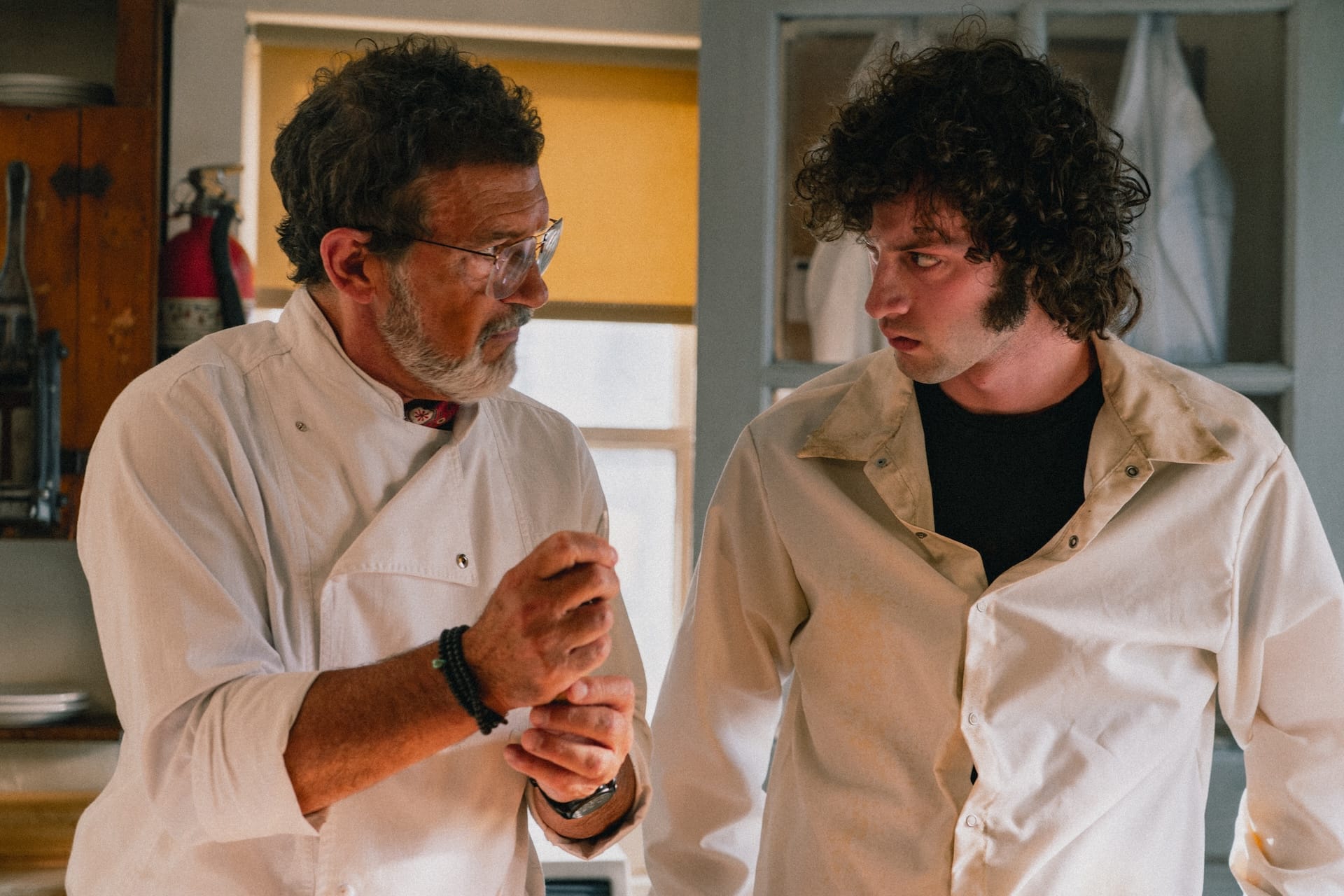
He’s balanced nicely against Banderas, quietly giving yet another wonderful performance in a career that has been as rich and varied as that of any actor of the last forty years. Chef here is neither a saint nor a tortured genius. Banderas finds the touches here to make the character more than a Mr. Miyagi figure, and his quiet confidence also belies a bit of selfishness. The Chef is so committed to his work and a functioning kitchen that he doesn’t really care if his cooks are doing lines of coke if it keeps them alert enough for their shifts. Such a blend of gravitas and humanity isn’t a rarity for Banderas, but it helps strike a balance between an aspirational figure for the young Bourdain and maintaining the reality of life in a kitchen.
Moreover, the thoughtful script doesn’t pretend that Bourdain had some deep, innate talent for cooking. Again, it leads with his desire to become a writer, and he only finds a way into a kitchen as a dishwasher because he has no other options. When Chef starts to take Tony under his wing, and Tony discovers he may have a love of cooking, it’s like we’re watching a live-action Ratatouille in that “anyone can cook.” Through montage and some physically painful trials (I saw this in a room full of back-of-house restaurant workers, and there’s a scene where Tony mishandles shucking an oyster that had people crying out, “No!”), Johnson highlights that there’s no secret to greatness; it’s all in the grind.
Tony’s journey here is seeing the kind of person he could become, especially compared to his violent, self-destructive colleague Sal (Leo Woodall), and starting to move towards something real about himself. It’s a wonderful counterweight to the standard biopic tale of “No one believed in my greatness, but now I’ve shown them all.” The Tony here was only a legend in his own head; it led him to be dishonest, reckless, and evasive, and it wasn’t until he ditched all that stuff and got down to the unglamorous work of waking up early, toiling all day, and connecting with others that he grew up. Rather than lording the legend of Anthony Bourdain over us, it reminds us that despite his fame, Bourdain was beloved in part because of his humanity and curiosity.
You could make the argument that this doesn’t even need to be an Anthony Bourdain movie given how little of his later life is present here. But I would counter that biopics benefit from specificity and a real conflict rather than playing the hits. Bourdain already gave us so much material in his own voice through his writing and shows that he speaks for himself even though he died in 2018. A movie about his young life shouldn’t be a replication of that material, but an entry point to what comes later – not only for Bourdain, but for anyone who can get over themselves long enough to realize that greatness can’t be a story you tell everyone and expect it to catch up. Sometimes you need that good ass-kicking.
Tony is now playing in theaters in wide release. Matt Goldberg is a film and TV critic who runs the newsletter Commentary Track.